

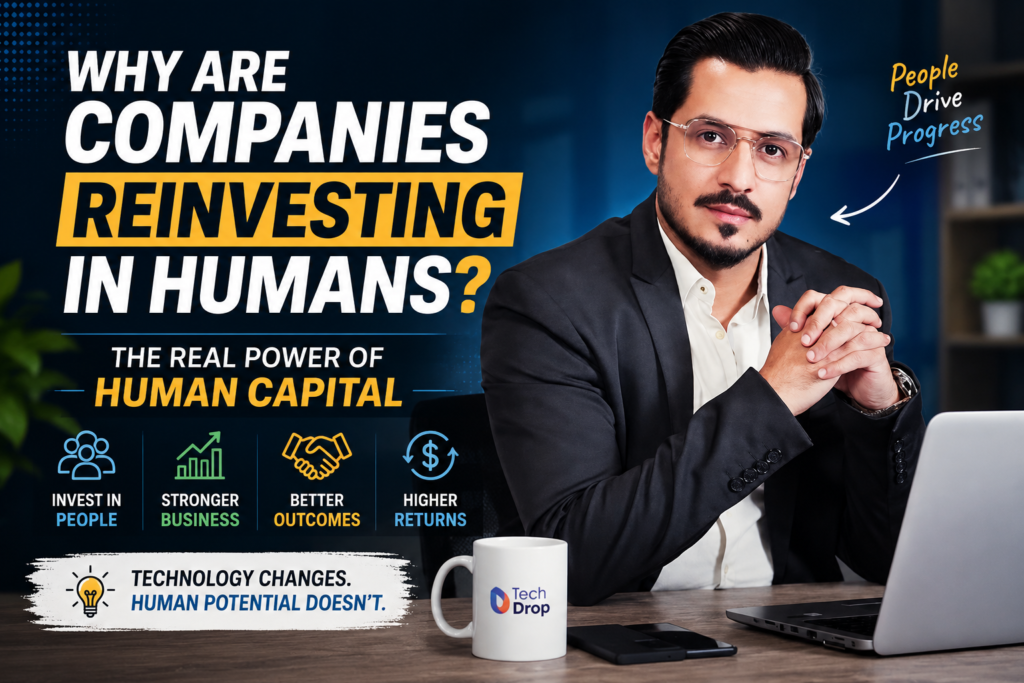
For the past few years, AI has changed the way we build and run a business. I have experienced this shift firsthand. Like many founders, I adopted AI tools, automation, and modern software to reduce manual work and speed up operations. It worked well in many areas.
But over time, I learned something that many entrepreneurs are now realizing.
Technology is powerful, but people remain the greatest asset of any company.
Today, I believe the smartest leaders don’t choose between AI and people. They combine both. They invest in technology while continuing to invest in human capital because that creates stronger companies, better products, happier customers, and sustainable growth.
In this article, I’ll share why I changed my perspective, why companies are bringing people back into the center of their strategy, and why investing in employees delivers the highest return over time.
Why are companies starting to invest in people again?
When AI became more capable, I embraced it across my businesses. At Tech Drop Pvt. Ltd. and Creative Creations, we introduced automation, AI coding assistants, content generation tools, and workflow systems to make our operations faster.
Initially, the results looked impressive. We completed repetitive tasks in less time and reduced manual effort. Like many founders, I believed technology could replace many roles.
Then reality appeared.
The more advanced our systems became, the more we discovered hidden costs. AI subscriptions became expensive. API usage increased every month. Security became more complex. Maintaining integrations required skilled developers. Fixing unexpected problems demanded experienced engineers.
That experience changed my thinking.
Today, I still invest in technology, but I also understand that investing in people creates something AI cannot replace. A skilled employee understands context, builds relationships, solves unique problems, and makes smart decisions when unexpected situations happen.
That is why many companies that invest in their teams are becoming stronger again.
What happens when businesses rely too much on AI?
AI is excellent at generating ideas, writing code, summarizing information, and automating repetitive tasks.
However, AI doesn’t fully understand your customers, your culture, or your long-term vision.
In my own company, I noticed that AI could generate thousands of lines of code. But someone still needed to review the architecture, optimize loops, secure APIs, improve performance, and think several steps ahead. Those responsibilities still belonged to experienced professionals.
Another challenge was cost.
Every AI request consumes tokens. Every integration requires maintenance. Every new model introduces another expense. Soon, the technology that was supposed to replace people actually required even more skilled people to manage it.
That’s why I don’t see AI replacing every employee. Instead, I see AI becoming a powerful assistant.
Technology should support people rather than replace them.
Why does every employee still create real value?
One lesson I’ve learned as an entrepreneur is simple.
Buildings don’t grow companies.
Software doesn’t grow companies.
People do.
Every employee brings experience, creativity, communication skills, and judgment that software cannot fully copy.
Whether someone works in development, design, sales, marketing, finance, or customer service, each person contributes something unique.
A motivated worker often finds better solutions than an automated system because human beings understand emotions, priorities, and changing situations.
This is where human capital leads to better results.
When your employees contribute ideas instead of simply completing tasks, your entire organization becomes stronger.
That is real capital.
Why should leaders prioritize human capital?
Many founders focus on reducing payroll because salaries look like a high cost.
I used to think that way too.
Today, I see salaries as an investment rather than a cost.
When leaders prioritize human capital, they create an environment where innovation becomes normal.
When people receive fair compensation, competitive wage packages, learning opportunities, and clear career paths, they feel respected.
Eventually, people feel supported, become more loyal, and produce better work.
That directly improves retention, lowers turnover, and helps every employer build a stable workforce.
If you truly want to invest in human capital, start by treating your team as partners rather than expenses.
How does investment in employees improve innovation?
Innovation rarely comes from software alone.
It comes from conversations.
It comes from experiments.
It comes from curious people asking better questions.
When a company makes continuous investment in learning, people develop new expertise, stronger problem-solving skills, and greater confidence.
This allows them to build better products and services.
Every entrepreneur wants innovation.
Innovation starts with investing in employees.
The more knowledge your team gains, the more ideas they generate. That creates better solutions for every customer.
This kind of strategic thinking creates a real competitive advantage.
Why is training and development more important than ever?
Technology changes every month.
The only way to keep up is through training and development.
I encourage every professional in my company to continue learning.
New programming languages appear.
AI tools evolve.
Cybersecurity standards change.
Customer expectations continue to evolve.
Without continuous learning, even talented people can fall behind.
The best practice is building a learning culture where everyone has the opportunity to grow.
That doesn’t simply improve technical skills.
It also builds confidence, leadership, communication, and better decision-making.
How does a strong company culture reduce employee retention problems?
Culture isn’t written on office walls.
Culture is how leaders behave every day.
As an entrepreneur, I try to demonstrate the values I expect from everyone around me.
I communicate openly.
I support learning.
I encourage collaboration.
I try to embody accountability.
When leaders behave this way, people stay.
Higher retention reduces hiring costs, protects company knowledge, and creates stronger relationships throughout the workplace.
An inclusive culture also welcomes different backgrounds, experiences, and diversity, allowing every employee to contribute their best work.
That creates higher engagement, greater satisfaction, and stronger commitment.
Can AI and employees work together instead of competing?
Absolutely YES.
This is the future I believe in.
AI handles repetitive tasks.
Humans handle thinking.
AI generates drafts.
People refine them.
AI speeds up coding.
Developers optimize architecture.
AI analyzes data.
Leaders make decisions.
This balance allows companies to increase efficiency without losing creativity.
It also helps reduce repetitive work while improving overall productivity.
Instead of replacing people, AI should enable every employee to focus on higher-value work.
That creates a better return on every technology investment.
What lessons have I learned from building multiple companies?
My entrepreneurial journey started with very limited resources in Dubai.
Since then, I’ve built businesses across Pakistan, the UAE, and the United States.
I’ve experienced success, made every possible mistake, learned difficult lessons, and continued growing.
One lesson stands above all others.
Never underestimate people.
Technology changes quickly.
Markets change.
Customers change.
But talented people continue solving problems.
Whether I build software at Tech Drop Pvt. Ltd., create visual campaigns at Creative Creations, or mentor young entrepreneurs, I always look for people with curiosity, integrity, and ambition.
Those qualities cannot be downloaded.
A strong company grows because its people grow.
What does the future of business look like?
I believe the future belongs to leaders who balance technology with humanity.
Every successful business will use AI.
Every successful business will automate routine work.
But the most successful companies will never stop investing in their people.
Human capital may become the biggest competitive advantage over the next decade.
Organizations that fail to develop their teams will struggle to adapt.
Those who cultivate learning, wellness, innovation, and trust will continue building long-term careers, lasting brands, and meaningful impact.
My advice is simple.
Don’t chase automation alone.
Build people who can build the future.
That is the most profitable path I know.
Final Thoughts
Throughout my entrepreneurial journey, I have learned that technology should strengthen people, not replace them. AI has transformed the way we work, but it has also shown me its limits. Behind every successful product, every satisfied customer, and every growing company is a team of people who think critically, solve complex problems, and care about the outcome. Software can automate tasks, but it cannot replace judgment, leadership, creativity, or purpose.
When I choose where to invest next, I still believe the best investment is in people. Companies that combine smart technology with talented, motivated employees will build stronger businesses, create lasting impact, and generate sustainable growth for years to come.