

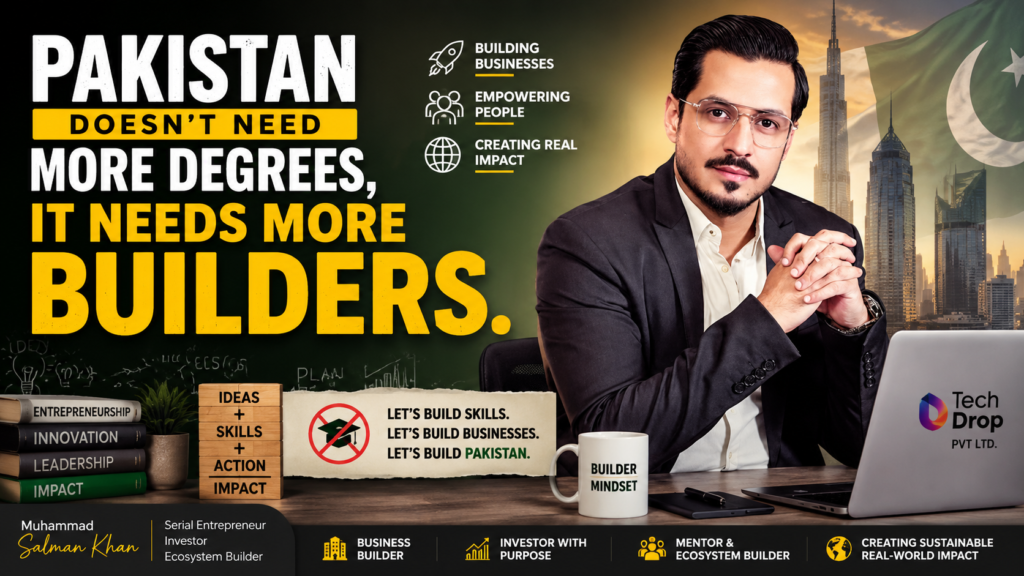
For decades, we’ve told young people that success begins with a degree. Study hard, get into a good university, graduate, and employment will follow.
But today’s reality tells a different story.
Across Pakistan, thousands of talented graduates struggle to find meaningful opportunities while businesses continue searching for people with the right skill set. The gap between education and employment keeps growing.
As someone who has built companies across Pakistan, the UAE, and the United States, I’ve seen this challenge from both sides. I’ve hired hundreds of people, mentored aspiring entrepreneurs, and worked closely with hiring managers across many industries.
What I’ve learned is simple: a piece of paper alone is no longer enough.
The world rewards people who can build, solve problems, and create value.
This doesn’t mean education has no place. It means the debate between degrees and skills needs a fresh perspective.
Pakistan doesn’t need more people waiting for opportunities. It needs more builders to create them.
In this article, I’ll share why skills are becoming the real currency of success, what employers actually look for, and how young people can prepare for today’s job market.
Why Is Pakistan Facing a Skill Gap Despite More Graduates?
Every year, thousands of students graduate from a university with hopes of securing stable employment. Yet many employers still struggle to find candidates who can contribute from day one.
The problem isn’t intelligence or ambition. The issue is alignment.
Our education system often rewards memorization instead of problem-solving. Students spend years preparing for exams but receive limited exposure to real-world challenges.
Meanwhile, the job market is changing quickly. Businesses need people who can communicate clearly, use digital tools, analyze data, and adapt to new technologies.
Research shows that employers increasingly value evidence that you’ve applied your knowledge rather than simply studied it.
Pakistan has no shortage of talent. What we lack is a stronger education and skills alignment.
Has the Job Market Changed Faster Than Our Education System?
The answer is YES.
Today’s job market is rapidly evolving because of technology, globalization, automation, and AI.
Entire job roles are changing faster than academic curriculum updates.
Ten years ago, few people talked about UX design, data analysis, AI tools, or design automation. Today, these capabilities influence many industries.
Companies need people who can learn new things quickly and apply them immediately.
Unfortunately, many courses taught in traditional institutions still focus heavily on theoretical concepts without enough applicable experience.
This creates a disconnect between higher education and the world of work.
Students often graduate with knowledge but lack the confidence to execute.
That is why developing skills alongside formal education has become essential.
What Do Employers Really Want in New Hires?
As someone who has built businesses like Tech Drop Pvt Ltd. and Creative Creations, I can tell you exactly what every employer wants.
We look for people who can solve problems.
A degree may help someone get an interview, but skill determines whether they succeed.
When I evaluate candidates, I ask myself simple questions:
- Can this person think independently?
- Can they communicate effectively?
- Can they learn new skills quickly?
- Can they work with a team?
- Can they deliver results?
Soft skills matter just as much as technical expertise.
Adaptability, decision-making, curiosity, and accountability often set you apart from equally qualified candidates.
Many hiring managers now prioritize portfolios, freelance work, open-source contributions, and internship experience because these provide tangible proof of capability.
An employer doesn’t just hire knowledge.
They hire potential, credibility, and execution.
Is a College Degree Still Valuable?
Let’s address the question directly.
Is a college degree still important?
Yes, but a degree still isn’t the whole story.
A college degree provides foundational knowledge, structure, and credibility. It introduces students to discipline, networks, and professional expectations.
For professions like medicine, engineering, law, and research, formal education remains essential.
A university environment also helps students build relationships and discover their interests.
However, traditional degrees alone no longer guarantee employment.
The most successful graduates combine academic learning with practical experience.
Think of a degree as a starting point rather than a destination.
The degree provides a foundation. Your skill determines how far you go.
Instead of asking whether skills without degrees can succeed, we should ask how education and skills can work together.
That shift in thinking changes everything.
Why Real World Experience Matters More Than Ever
When I launched my first business in Dubai, I had limited resources but endless determination.
I learned lessons that no classroom could teach.
Negotiating with clients, managing cash flow, building teams, and handling setbacks gave me hands-on experience that shaped my career path.
Experience teaches what textbooks cannot.
This is why gaining hands-on experience should begin long before graduation.
Students should actively pursue:
- Internship opportunities
- Apprenticeship programs
- Volunteer projects
- Freelance work
- Startup competitions
- Community initiatives
Even small projects build confidence.
Real-world experience shows an employer that you can apply knowledge in practical situations.
It also helps you discover what type of work genuinely excites you.
Which Skills Create Opportunities in Today’s Economy?
Every industry needs builders.
Whether you’re interested in technology, healthcare, finance, media, or hospitality, certain skills like communication, creativity, and critical thinking remain valuable.
Digital capabilities are especially important.
Areas with strong demand include:
- Coding and software development
- Digital marketing and SEO
- Analytics and data analysis
- Content creation
- Project management
- Design and UX
- Sales and lead generation
- AI implementation
At Tech Drop Pvt Ltd., we’ve seen firsthand how businesses increasingly seek skills-based talent.
At Creative Creations, we use AI, storytelling, video production, and automation to help brands grow faster.
The future belongs to people who combine technical expertise with human creativity.
Your skillset should evolve continuously because industry trends change quickly.
The ability to learn new things will become one of the most valuable skills of all.
Can Certifications and Alternative Learning Paths Replace Traditional Education?
Alternative learning options have expanded dramatically.
Platforms like Coursera and LinkedIn Learning allow anyone to gain valuable knowledge from anywhere.
Bootcamps, workshops, certification programs, and micro-credentials help people develop targeted expertise in specific domains.
A certificate alone won’t guarantee success, but the right credential can carry weight when combined with practical work.
For many learners, these options offer flexibility that traditional education cannot provide.
I’ve met self-taught professionals who outperformed candidates with advanced degrees because they invested time in building applicable expertise.
Whether you pursue a diploma, certification, or university education, your focus should remain the same.
Learn useful skills.
Build projects.
Demonstrate results.
That’s what makes you employable.
How Can Young People Build Their Portfolio Before Graduation?
Your portfolio tells your story better than your resume.
It provides evidence that you’ve completed meaningful work.
You don’t need years of experience to start building one.
Begin by documenting projects, freelance work, volunteer activities, or open-source contributions.
Create a simple online platform where you showcase your achievements.
Share case studies, lessons learned, and measurable outcomes.
If you’re interested in digital marketing, run campaigns for local businesses.
If you enjoy coding, build simple applications.
If you’re passionate about content creation, publish consistently.
Your portfolio becomes proof of your capabilities.
It gives you an edge because employers can see evidence that you’ve done the work.
Remember, credibility comes from action.
Not intention.
Why Entrepreneurship Is a Powerful Career Path
I believe entrepreneurship is one of the strongest forces for change.
Builders don’t wait for opportunities.
They create them.
When I returned to Pakistan after more than a decade in Dubai, my mission was clear.
I wanted to invest in people, build businesses, and create sustainable impact.
Today, our ventures support hundreds of professionals across multiple sectors.
Entrepreneurship isn’t limited to starting a company.
It’s a mindset.
Builders identify problems and design solutions.
They embrace adaptability.
They create value for others.
Not everyone needs to become a founder, but everyone can think like one.
This mindset strengthens employability and supports long-term growth.
Freelancers, creators, and innovators all contribute to a stronger workforce.
Pakistan needs more people willing to build solutions instead of waiting for someone else to create them.
What Does the Future Workforce in Pakistan Need?
The future workforce will reward people who combine knowledge with execution.
Education matters.
Skills matter.
Character matters.
The strongest professionals develop a balanced path that includes formal education, practical experience, and lifelong learning.
The future belongs to people who can adapt, collaborate, and create.
Many industries are shifting toward skills-based hiring because employers care more about outcomes than titles.
As AI continues to reshape the workplace, uniquely human capabilities like creativity, communication, and problem-solving will become even more valuable.
Our goal should not be to produce more graduates.
Our goal should be to produce more builders.
People who create businesses.
People who solve challenges.
People who strengthen communities.
People who inspire others.
Pakistan already has extraordinary talent.
Now we need the systems, mindset, and support to unlock it.
Final Thoughts
After building businesses across multiple countries and working with professionals from different backgrounds, I’ve realized one thing.
Success rarely depends on where you studied.
It depends on what you can build.
A degree can open doors, but your skills keep those doors open. Education gives you a foundation, but action creates momentum.
The future belongs to people who take ownership of their growth, stay curious, and continue learning.
If you’re a student, don’t wait until graduation to start building.
If you’re a professional, keep upgrading your skills.
If you’re an entrepreneur, invest in people and create opportunities.
Pakistan doesn’t need another generation waiting for jobs.
It needs builders who create them.
And the best time to start building is TODAY.