Leadership vs Management: What Matters More in Business Growth?
Discover the key differences between leadership and management with Muhammad Salman Khan, and learn which skill truly drives business growth and success.
5/18/20267 min read

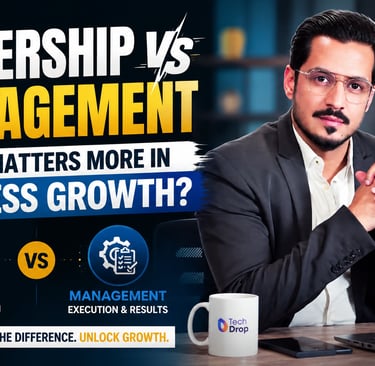
When people talk about business success, they often compare leadership vs management as if one is more important than the other. In my experience, both matter deeply, but they serve different purposes. I’ve spent years building companies across technology, hospitality, media, consulting, and social impact, and I’ve learned that growth becomes difficult when you focus only on management or leadership.
From building Tech Drop Pvt. Ltd. to expanding The Barbers Cafe and leading FreeFoodSharing, I’ve seen how leadership and management work together to shape strong businesses. One helps create vision, while the other turns that vision into action. If you want to scale a company, build a strong team, and create long-term impact, you need to understand the difference between leadership and management.
In this article, I’ll share my real experiences as an entrepreneur and explain what truly matters more in business growth.
What Is the Difference Between Leadership and Management?
One of the biggest lessons I learned in business is that leadership and management are not the same thing. Many people use these terms together, but there is a clear difference between leadership and management. Leadership focuses on setting direction, inspiring people, and building belief within a team. Management is the practice of organizing people, systems, and resources to achieve specific goals.
When I started my first company in Dubai, I had a strong vision but limited systems. I knew how to inspire people and sell ideas, but I struggled with structure. Over time, I realized that an effective leader must also understand execution. Without planning, budgeting, and clear processes, even the best ideas fail.
This is the key difference most entrepreneurs miss. Leaders set the VISION, while managers make sure the work gets done properly. Leadership is fundamentally about influence, while the management role focuses on control, organization, and measurable results.
Why Do Businesses Need Both Leadership and Management?
A company cannot survive with only visionary thinking. At the same time, businesses also fail when they only focus on rules and processes. That is why leadership and management must work together.
At Tech Drop Pvt. Ltd., I learned that scaling a business requires balance. Some days I need to think strategically about expansion, partnerships, and innovation. Other days, I need to allocate resources, monitor project management, and ensure deadlines are met. This overlap between leadership and management becomes critical during growth stages.
Many startup founders are visionary by nature. They inspire people and attract opportunities. But without systems, operations become chaotic. On the other hand, some managers are excellent at handling day-to-day operations, but they struggle to inspire their team or create a larger mission.
The best businesses develop both leadership and management from the beginning. That combination creates stability, direction, and organizational success.
How Does a Leader Think Differently From a Manager?
A manager often focuses on process, structure, and efficiency. A leader focuses on people, growth, and the future. Both mindsets are important, but their approaches are different.
When I launched Creative Creations, my objective was not only to build a content studio. I wanted to create a platform where young creatives could explore their full potential. That required visionary leadership. I had to inspire people to believe in something bigger than monthly targets.
Managers are leaders in many situations, but leadership differs from management because leaders often go beyond systems. They challenge old ways of thinking and encourage innovation. A leader’s job is to create belief and momentum even during uncertainty.
John Kotter, one of the most respected voices in management and leadership, explained that management focuses on handling complexity, while leadership involves setting direction and motivating people. I strongly agree with Kotter because I’ve experienced this reality in every business I’ve built.
Can Managers Become Great Leaders?
ABSOLUTELY YES... Some of the best managers I have worked with later became strong leaders because they learned how to connect with people emotionally, not just operationally.
At The Barbers Cafe, I’ve seen team members grow from supervisors into leadership positions because they developed emotional intelligence and strong communication. A great manager knows how to maintain systems, but an effective leader learns how to build trust and inspire people.
The transition happens when someone stops thinking only about tasks and starts thinking about people. Leaders motivate their teams by giving meaning to work. They create a vision for the team and help employees see personal and professional growth inside the company.
This is why I always encourage my teams to cultivate leadership qualities early. Strong leadership skills are not only for CEOs. Every department head, supervisor, and team lead should focus on developing the ability to influence others toward a shared vision.
What Management Skills Help Businesses Grow Faster?
Business growth depends heavily on strong management skills. No matter how powerful your vision is, poor execution can destroy momentum.
At One21 Consulting, we specialize in providing tailored visa consultancy for study, business, and visit visas across the globe and helping organizations navigate leadership vs management challenges by improving systems, operations, and decision-making so resources are allocated correctly, deadlines are met, budgets are protected, and communication is strengthened.
Effective management requires discipline. You must master planning, reporting, hiring, and operational structure. Good systems improve team performance and reduce confusion. This is especially important when companies scale across multiple cities or countries, as mine have.
I also learned that management style affects company culture. Micromanagement creates stress, while structured empowerment creates confidence. The goal is to improve team productivity without killing creativity. That balance helps businesses grow sustainably.
Why Leadership Skills Matter During Difficult Times
The true test of leadership comes during uncertainty.
Anybody can lead when everything is going WELL. Real leaders appear during a CRISIS.
I remember difficult moments when businesses faced financial pressure, market uncertainty, and operational challenges. During those times, my team not only needed instructions. They needed confidence. They needed someone who could inspire and motivate their teams despite the pressure.
Leadership focuses on setting hope during difficult moments. Leaders inspire people by remaining calm and focused. Team members watch the energy of a leader closely. If leadership becomes fearful, the entire organization feels unstable.
During challenging phases, I learned that an effective leader must communicate honestly while still protecting morale. A leadership role is not about pretending problems do not exist. It is about helping people believe that solutions are possible.
That mindset helped me foster resilience inside my companies and nonprofit initiatives.
How Do Leaders and Managers Handle Team Members?
One major difference between leadership and management appears in how people are treated. Managers focus on performance metrics, while leaders focus on developing people.
At Mydesk.pk, I work with professionals from different backgrounds and industries. I noticed that employees perform better when they feel valued. Leaders focus on the future of people, not just output. They build trust, encourage learning, and support professional development.
Managers may monitor performance, but leaders inspire growth. Good leaders understand that employee engagement improves when people feel respected and heard.
I always tell my teams that businesses are built by humans, not systems alone. When leaders motivate their teams and focus on developing individuals, the company culture becomes stronger. That culture creates loyalty and long-term success.
Leadership vs Management: Which One Drives Innovation?
Innovation usually starts with leadership. Execution usually comes through management.
When I returned to Pakistan after spending years in Dubai, I wanted to bring fresh thinking into local industries. Whether it was introducing modern branding ideas through Creative Creations or redefining grooming culture with The Barbers Cafe, innovation required visionary leadership first.
Leaders set ambitious goals. They encourage experimentation and push people to think differently. Leadership style shapes how much creativity exists within an organization.
However, innovation without execution becomes chaos. Management and leadership must support each other. Once a new idea is introduced, management systems help turn that idea into measurable results.
This is why the debate around management vs leadership should not become a competition. Businesses need both. One creates movement, while the other creates stability.
How Can Entrepreneurs Develop Leadership and Management Skills?
I believe every entrepreneur should actively develop leadership and management skills together. One without the other creates an imbalance.
The first step is self-awareness. You need to understand your natural strengths and weaknesses. Some founders are visionary but lack operational discipline. Others are process-driven but struggle to inspire their team.
I personally improved by learning from mentors, studying successful founders, and observing how leaders and managers behave under pressure. I also focused on emotional intelligence because business is ultimately about people.
To develop leadership, entrepreneurs should improve communication, decision-making, and confidence. To master management, they should learn planning, operations, budgeting, and resource allocation.
Developing both skill sets takes time, but it creates stronger businesses and stronger people.
What Matters More for Long-Term Business Growth?
People often ask me, “What’s the difference between management and leadership when it comes to growth?” My answer is simple. Long-term success requires BOTH.
Leadership focuses on setting direction and creating purpose. Management ensures that resources to achieve business goals are used properly. One drives vision, while the other drives execution.
If I only focused on leadership, my businesses would lack structure. If I only focused on management, my companies would lose creativity and inspiration. Sustainable growth happens when a leader and a manager work together, even if they are the same person.
In my own journey, I learned that leadership is about impact. It is about helping people grow, creating opportunities, and leaving a meaningful legacy. Management ensures those dreams become reality through systems and consistency.
The businesses that survive for decades are usually led by people who understand the distinction and know when to lead with vision and when to manage with discipline.
Final Thoughts
As someone who has built businesses across different industries and countries, I can confidently say that leadership and management are both essential for organizational success.
Leadership helps inspire people, create direction, and drive innovation. Management helps organize resources to achieve specific goals and maintain stability. Together, they create powerful businesses that can grow, adapt, and survive challenges.
I’ve learned that good leaders focus on the future, while great managers focus on execution. But the strongest entrepreneurs learn how to do both.
Whether you are starting your first company or managing an established organization, focus on developing both skill sets. Learn how to inspire and motivate their teams while also building systems that support long-term growth.
That balance changed my businesses, my leadership journey, and my understanding of success itself.