How to Validate a Business Idea: 5 Steps to Validate Your Startup Idea
Validate your startup idea & ensure market need. Learn 5 steps to validate your business idea and determine if your target market will buy your product.
5/12/20265 min read
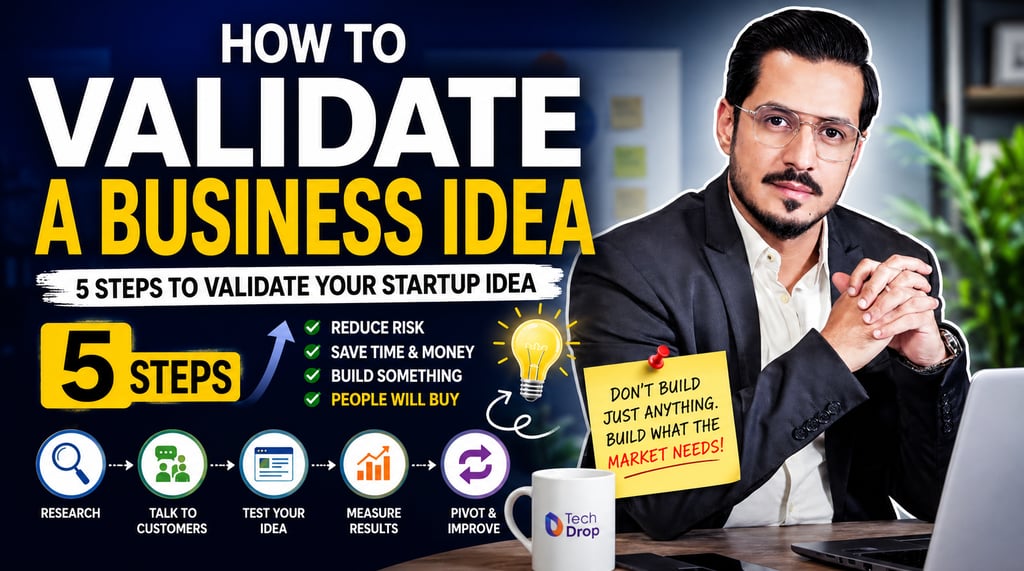

When I look back at my journey as an entrepreneur, I’ve learned one truth the hard way: not every great idea becomes a great business. Many people fall in love with an idea or product before checking if the market truly wants it.
That is why learning how to validate your startup idea matters so much.
I’m Muhammad Salman Khan, and I’ve built ventures across Pakistan, the UAE, and the United States. From my first business in Dubai with limited resources to leading multiple companies today, I’ve seen that smart founders do not guess; they test.
In this guide, I’ll share the same practical system I use to validate your business idea, reduce risk, and build with confidence.
What Does It Mean to Validate a Startup Idea?
To validate a startup means proving that real people want what you plan to offer. It means checking whether your business idea solves a real need and whether customers are willing to pay.
I always tell every founder this: assumptions are dangerous. Your family may love your idea. Your friends may praise it. But the market gives the real answer.
Market validation is the process of testing your concept before spending too much money, energy, or time and resources.
Simple questions I ask:
Does this product solve a real problem?
Who is the target customer?
Is there a large enough market?
Will people buy your product or service?
Can this become a profitable business model?
That is the heart of idea validation.
Why Do Most Startup Businesses Fail Without Market Validation?
I have seen many talented people start a new startup with passion but no proof. They invest money, hire staff, build offices, then discover demand doesn’t exist.
The biggest reason failure happens is that they build something nobody truly needs.
Many founders skip customer feedback because they think speed matters more than learning. But speed in the wrong direction creates losses.
Without market validation, you may face:
Wrong pricing
Weak value proposition
Poor target market
No repeat customers
Low sales
Bad market fit
As an entrepreneur, I learned that testing early saves pain later. It is better to hear the hard truth in week one than lose savings in year one.
Step 1: Identify the Real Problem You Want to Solve
Every strong startup begins with a real problem. If there is no pain, there is no reason to pay.
Before I start anything, I ask: what exact pain point exists, and who feels it daily?
For example:
Long waiting times
Poor service quality
High prices
Lack of trust
Outdated systems
Your initial idea may sound exciting, but excitement alone is not enough. You must understand the people behind your idea.
Use this method:
Write the top 3 problems customers face
Describe your ideal customer
Explain how your solution is better than anything available now
Define your clear value proposition
When you clearly identify problems, you move from guessing to solving.
Step 2: Research the Market and Study Demand
The second step is checking if enough people care. This is where numbers matter.
I often use tools like Moz, Google Keyword Planner, and other SEO platforms to study search volume. If thousands of people search monthly, that can signal demand.
Look for:
Monthly searches
Monthly search volumes
Rising trends
Buying intent keywords
Local demand
Industry growth
This helps estimate market size and possible market share.
Also ask:
Is there room for a new business?
Is the market for your business growing?
Are people actively searching for solutions?
When many people search, it often means the problem is real.
This research gives me a stronger understanding of how your product fits into customer demand.
Step 3: Talk to Real Customers Before You Build
This is where many founders fail. They spend months creating products but never talk to users.
I strongly recommend customer interviews before development.
Speak with:
Potential customers
Existing buyers in the niche
Industry experts
One interviewee at a time
Product managers who sell B2B tools
Ask common questions like:
What frustrates you most?
What solutions do you use now?
What do you dislike about existing products?
Would you pay for a better solution?
What would make you switch?
The insights you gain are gold. Often, your first concept changes after these talks.
This is where many ideas go back to the drawing board, and that is a good thing.
Step 4: Create a Simple Landing Page or MVP
Once I see demand, I do not build the full product immediately. I test small first.
I create a landing page that explains the offer clearly and collects email addresses from interested people.
Your page should include:
Clear headline
Strong value proposition
Benefits
Call to action
Signup form
Early offer
You can also run Facebook ads to send traffic.
Another option is a minimum viable product, which is the smallest version that works. It helps you test a product fast.
Examples:
Demo service page
Prototype app
Pre-order form
Trial version
Waitlist
Even Dropbox famously used a simple demo approach early.
Do not overbuild. First, learn whether people will buy your product.
Step 5: Measure Results and Decide Whether to Pivot
This is the stage many people ignore. Data must guide decisions.
After testing, review:
Click rates
Signups
Replies
Sales calls booked
Actual purchases
Feedback quality
If people love the concept, move forward and launch your startup.
If results are weak, improve messaging, pricing, or audience. Sometimes you need to pivot into a stronger angle.
A pivot is not failure. It is smart leadership.
I have adjusted businesses many times. Strong founders stay flexible.
This is one of the most important steps to validate any concept.
Also Read: 10 Habits of Highly Successful Entrepreneurs
How Founders Can Check Competition and Market Fit
Some people avoid crowded markets. I often see competition as proof that demand exists.
Do a simple competitive analysis:
Who are the top players?
What do they do well?
Where do customers complain?
How can you meet their needs better?
Then focus on market fit.
Your product wins when it:
Solves a real issue
Delivers value fast
Is priced fairly
Creates trust
Fits into the market
In b2b sectors, buyers care about ROI, speed, and reliability. In consumer markets, convenience and emotion matter more.
Your offering that not only addresses pain but also feels easy to buy usually wins.
Mistakes New Entrepreneurs Make During Idea Validation
Over the years, I’ve seen repeated mistakes in entrepreneurship.
Common errors:
Building too early
Ignoring feedback
Asking only friends
Chasing vanity likes
No clear roadmap
Weak pricing strategy
No test budget
Skipping customer calls
Assuming demand
Another mistake is trying to outsource learning through outsourcing. Some tasks can be outsourced, but customer understanding cannot.
Some people join every accelerator but still never talk to users.
Remember, no program can replace real market learning.
My Personal Roadmap for Building a Startup That Lasts
When I started in Dubai, I had limited money but a strong belief. What helped me most was action mixed with learning.
My personal roadmap today looks like this:
Phase 1: Validate Fast
Define problem
Test audience
Collect feedback
Confirm demand for your product
Phase 2: Build Lean
Create MVP
Add only core features
Set up payment processing
Focus on first paying customers
Phase 3: Grow Smart
Improve systems
Hire carefully
Build brand trust
Use referrals
Phase 4: Scale with Purpose
Expand regions
Form partnerships
Explore crowdfunding
Invest back into growth
That is how I approach building a startup that lasts.
If I were starting a business today from zero, I would still begin with validation first.
Final Thoughts
If you want to launch something meaningful, do not wait for perfection. Test early, learn fast, improve often.
A strong startup idea is not the one that sounds smartest. It is the one customers truly want.
Whether your product doesn’t exist yet or you already have an initial idea, start speaking to real users now. Keep answering these questions honestly:
Who needs this?
Why now?
Why me?
Why will they pay?
That discipline can help you create an offering that wins.