
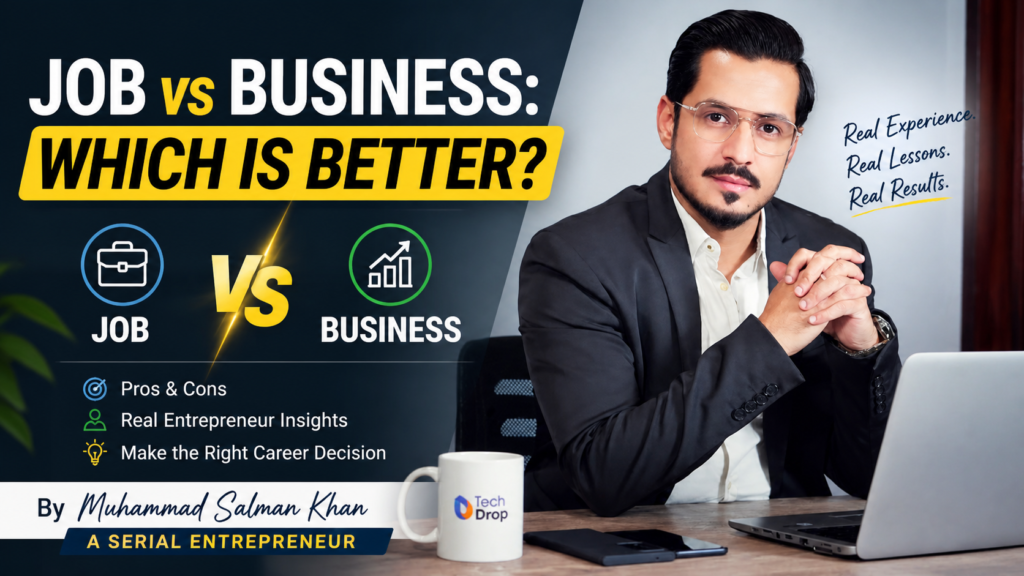
When people ask me about job vs business, I always say there is no single answer for everyone. The right path depends on your mindset, goals, family needs, and risk tolerance. Some people love a stable routine and a monthly income. Others dream of owning a business and building something bigger than themselves.
I’m Muhammad Salman Khan, and I’ve lived on both sides. I have worked jobs, built startups, taken losses, created opportunities, and grown businesses across different countries. In this article, I’ll share my real experience so you can decide whether a job or a business suits your life. If you are confused about job vs business, or becoming an entrepreneur, this guide will help you make a smart decision.
What Are the Real Differences Between a Job vs Business?
The biggest differences between a job and a business come down to control, income style, and responsibility. A job usually means you are employed by a company. It involves working for an employer, following systems, and completing assigned tasks.
A job often gives you:
- Monthly salary
- Clear work hours
- Team support
- Fixed duties
- Predictable routine
A business is different. As a business owner, you take responsibility for growth, team hiring, sales, and planning. Business involves uncertainty, but it can also create much higher rewards.
In simple words:
- A job pays for your time
- A business can pay for the value you build
That is why job vs business is one of the most significant choices in adult life.
Why Do Many People Choose Jobs First?
Many people choose jobs because they provide stability. A stable job helps people manage rent, groceries, school fees, and family needs. You receive a regular paycheck, which supports budgeting and financial planning.
A job also gives:
- Job security
- Health benefits in some companies
- Experience
- Professional network
- Professional development
For many families, this is the smart first step. My own sister is happy in her career. She has a strong designation and always says, “I don’t want to take a risk. I’m happy with 9 to 5.” I respect that. If someone feels fulfilled in a job, they should continue proudly.
Not everyone needs to become an entrepreneur. Some people thrive within a structured environment and enjoy a clear career path.
Why Does an Entrepreneur Prefer Owning a Business?
An entrepreneur usually wants freedom, ownership, and impact. I personally wanted to build something that could create jobs and solve problems. That desire pushed me toward entrepreneurship.
With business, you can:
- Create your own vision
- Make decisions
- Build teams
- Scale income
- Enter new markets
Unlike a job, a business gives you a chance to grow beyond your own time. A business allows you to create systems that work even when you sleep.
Also, in a job, you mostly work for yourself and your family. In business, you work for yourself and help others as well by creating employment and opportunities.
That purpose matters deeply to me.
What Are the Pros and Cons of Running a Business?
Let’s be honest. Business is not easy. Many social media posts show luxury, but they hide the hard part.
Pros and cons of business
Pros
- Unlimited earning potential
- Freedom to choose direction
- Chance to build wealth
- Strong personal growth
- Opportunity to create a legacy
Cons
- Risk of loss
- Long hours
- Stress
- Team issues
- Slow results in the early stages
Running a business involves solving problems every day. Some months are excellent. Some months test your patience. That’s why resilience matters.
Still, many successful entrepreneurs accept these challenges because the reward can be life-changing.
Can You Do a Job and a Business Together?
Yes, and this is often the smartest route. I strongly recommend starting a side hustle while employed. You get the best of both worlds.
You keep your fixed salary while testing ideas.
Examples:
- Freelancing
- E commerce
- Digital agency
- Small trading
- Stock market investing
- Content creation
Doing a job and a business together helps reduce fear. If the side income grows steadily, then you can move into a full-time business later.
This is a practical answer for people who are confused about a job or a business.
How Saving Salary Can Help You Start a Business
I always tell people this: if your monthly expenses are 100k and your job gives you 150k, save that extra 50k.
That saved money can become seed capital.
When I was doing my job, I often worked for six months, saved from that salary, then took the risk of starting small hustles and initiatives. Some worked. Some failed. But every step taught me something valuable.
Use your income wisely:
- Build emergency savings
- Learn investing
- Save for tools
- Test a small business
- Prepare for launch
This is how you make an informed move instead of jumping blindly.
Is Job Security Better Than Business Freedom?
This depends on personality. Some people value peace and routine. Others value freedom and challenge.
A job may give:
- Predictable income
- Paid leave
- Defined role
- Better short-term financial security
Business may give:
- Higher long-term upside
- Independence
- Flexible schedule
- Bigger growth potential
But remember, business comes with pressure. Some business owners often work more hours than employees.
If you want a calmer life now, choose employment. If you want to create something larger, a business might suit you.
The right choice depends on your stage of life.
What Skills Help in Entrepreneurship and Business Success?
I’ve seen talented people fail because they lacked discipline. And I’ve seen ordinary people win because they stayed consistent.
For business success, focus on:
- Communication
- Sales
- Leadership
- Patience
- Money management
- Problem solving
- Resilience
Many entrepreneurs often underestimate learning. You must study markets, customers, and numbers.
If you stay in a job, keep learning too. Promotions come to those who improve. Strong career growth depends on skill, not luck.
Whether job or business, learning helps you win.
How to Make the Right Career Decision for Your Future
If you are choosing between a job and a business, ask yourself:
1. What lifestyle do I want?
Do you prefer routine or freedom?
2. What is my risk tolerance?
Can you handle uncertain income?
3. Do I need money urgently?
Then a job often helps first.
4. What are my strengths?
Sales, management, creativity, operations?
5. What goals truly align with your goals?
Choose what fits your values.
This process will help you make an informed choice that supports your future.
My Personal Journey from Job to Business
My journey started with vision and hustle. I worked, saved money, tested ideas, and kept moving. I did not wait for perfect conditions.
I launched ventures in Dubai with limited resources, then expanded across Pakistan, the UAE, and the US. I learned that success is built one step at a time.
Sometimes I choose business instead of comfort. Sometimes I invested profits into new ideas. Sometimes I failed and restarted.
That is the reality of an entrepreneurial life.
Today, what gives me the most joy is not only income. It is seeing teams grow, families supported, and opportunities created.
That is why I believe entrepreneurship can be a force for good.
Final Thoughts: Business or Job?
So, business or job, which is better?
My honest answer: both can be excellent. Both have unique advantages and disadvantages.
If you love stability, structure, and a monthly income, choose a job with pride. If you dream bigger, enjoy risk, and want to create opportunities, explore business.
You can also start with a job and build a side hustle. Save money, invest smartly, and move when ready.
The smartest path is not what others choose. It is the path that depends on your goals, values, and courage.
I believe success comes when your actions align with your purpose.
If you need personal guidance on choosing the right path, growing a business, starting a side hustle, or making smart career moves, feel free to connect with me for consultation. Sometimes one clear conversation can save years of confusion and help you move forward with confidence.
FAQs
Should I leave a traditional job to start a business?
I weighed this a lot. I left a traditional employment role after I understood the benefits of having a job and what a business means to me. Many jobs provide steady income and predictable job offers, while launching my own business brought me uncertainty and freedom. I suggest you make an informed choice that aligns with your goals, finances, and risk tolerance. Especially in the early stages, a job can cover your bills while you build a sustainable business.
What are the main differences between a job and a business?
When I compare a job vs. a business, one of the primary differences is how you trade time for money. In a traditional job, I had a set salary, benefits, and a clearer work-life balance, while a business required me to handle business expenses, make business decisions, and create systems that earn without me at every hour. Understanding the differences helped me plan for long hours and stress when needed, and for a better work-life balance later if I built a successful business.
How do I handle long hours and stress when starting a business?
I learned that business is not easy and that long hours and stress are common, especially in the early stages. I set small goals, hired help for tasks I hate, and tracked business expenses so I wouldn’t be surprised by costs. I also reminded myself why I started and focused on building a sustainable business rather than quick wins. If stress gets too big, I step back to rest and protect my health—no success matters without it.
Can I keep a job while launching my own business?
I kept a job while launching my own business at first. Many people do this to reduce risk because traditional employment gives steady pay and benefits while you test your idea. Balancing both is hard but doable: I used evenings and weekends, tracked my time, and kept my boss informed when needed. This approach helped me fund business expenses and learn what customers wanted before I left my job.
What are the financial benefits of a job vs a business?
I noticed that a job offers steady pay, benefits, and sometimes retirement plans—these are clear benefits of having a job. A business can offer higher income and control, but it also brings irregular revenue and business expenses. For me, the job provided safety early on, while the business opened doors for growth. I recommend planning savings to survive economic downturns when you start a business.
How do I know if a business will be successful or sustainable?
I look for real signs: customers paying repeatedly, low customer acquisition cost, and clear demand. A successful business needs good cash flow, sound pricing that covers business expenses, and a plan to scale. I test ideas cheaply, learn from feedback, and pivot fast. If I can see a path to better work-life balance and steady profits, I call it a sustainable business.
What should I consider before making the switch from employee to business owner?
I asked myself a few honest questions: Do I have savings to cover months of no income? Do I understand my market and the costs to make the business run? Can I handle rejection and instability during economic downturns? I also weighed personal fulfillment and whether I wanted control over decisions. If you plan to make business your path, start small, validate demand, and keep one foot in a job if you can until things look real.