

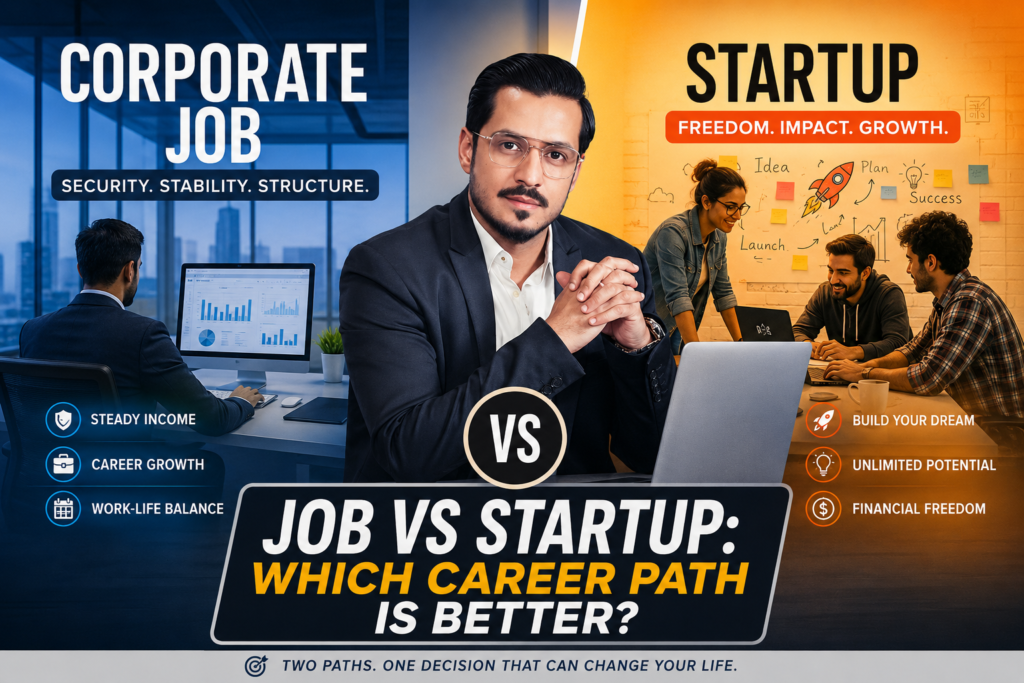
I get asked this question all the time: “Job vs Startup: Which is better?” Should you take a stable corporate job, or should you join a startup and bet on something unproven? I have lived on both sides of this decision. I spent over a decade in Dubai building a successful company from scratch, and today I lead a portfolio of businesses across technology, hospitality, coworking, and digital media in Pakistan, the UAE, and the United States. I am also an Equity and Technology Partner at GoLive Streamer, a fast-growing tech startup in the social streaming space, so I still see this choice from the inside every single day.
There is no universal right answer here. The best career path depends on your risk tolerance, your financial needs, your immediate goals, and what stage of life you are in.
In this article, I will compare a startup and a corporate job across pay, growth, stability, and culture, based on what I have seen firsthand as a founder, employer, and mentor, so you can make the decision that actually fits you.
Job vs Startup: Which is Better?
Before I go deeper, here is the short version.
A corporate job gives you a steady salary, structured benefits, and a predictable career path.
A startup gives you speed, ownership, and a faster learning curve, but it asks you to take on more risk and less certainty.
Neither company type is better in every case, and comparing them side by side only helps once you know what you personally value most right now.
Read Also: Job vs Business: Which is Better?
Compensation, Benefits, and Job Security
Corporate jobs usually pay a higher base salary from day one, and that base tends to grow at a consistent, predictable pace. You also get benefits like health insurance, retirement contributions, and paid leave that most startups cannot match in their first year. A corporate employer offers more job security too, since an established company typically has the resources and reserves to survive a slow quarter without cutting staff.
A startup often pays a smaller base salary, but it may offer equity as part of the package. That equity can bring a greater long-term reward if the company becomes successful, or it can be worth nothing if the venture does not survive. I have watched founders build something out of nothing, invested my own time and money into new ventures, and also seen promising ideas fail. Data on failure rates shows a large share of startups do not make it past their first few years, so you need to go in with a clear expectation. If you are the sole earner in your family or you are carrying debt, that risk deserves extra thought before you make the decision.
Learning and Career Growth
This is where startups usually win, and it is one reason I still believe in them. When I built my first company in Dubai, I did not have the luxury of a big team or a dedicated department for every function. I handled sales, operations, and client relationships myself, and I learned faster because of it. Startups force you to wear many hats, acquire new skills on the job, and progress at a pace that a bigger business rarely allows.
Corporate jobs offer a different kind of growth. You get structured training, real mentorship from experienced managers, and the chance to build deep, specific expertise in one area. If you want to master a specialised skill, earn a certification, or follow a clear career development track, a corporate environment gives you the resources, the structure, and the time to do it properly. Both paths build a strong professional foundation. They just get you there in very different ways.
Company Culture and Work Environment
Startup culture tends to be informal, lean, and fast-moving. Decisions happen quickly because there are fewer layers of management between an idea and its execution. I have always valued that speed. When I returned to Pakistan after years in Dubai, I brought that same mindset with me, combining global business practices with local opportunity and local talent to build things quickly rather than waiting for a long approval process.
Corporate culture is more structured. There are clear roles, defined processes, and established systems and services that keep large organizations running smoothly and consistently. Some people thrive inside that structure. Others find it slow and frustrating and prefer a leaner, more direct lifestyle at work. Neither style is wrong, but you should be honest with yourself about which one fits how you actually focus and perform best.
Read Also: Should I Quit My Job to Start a Business?
Management Structure and Career Path
In a startup, you often report directly to the founder or a small leadership team, and you get an inside view of real business decisions. The career path is less predictable because the company itself is still figuring out its own direction and its place in the market. I know this well, since my role across my own ventures goes far beyond ownership. I work closely with teams and partners every day to build strategy, allocate resources, guide investment decisions, and shape direction as we go, and I try to bring genuine leadership rather than just a title.
In a corporate job, the career path is usually clearer. You know what a promotion looks like, what skills you need to earn it, and roughly how long it will take to get there. If predictability and a stable, established structure matter to you, this kind of environment can bring real peace of mind and a stronger sense of direction.
Pros and Cons of Working at a Startup
- Pros: Faster learning, more ownership, direct impact on the business, potential equity upside
- Cons: Lower job security, less structured benefits, higher risk of the company failing
Pros and Cons of a Corporate Job
- Pros: Stable salary, strong benefits, structured training, clear promotion path
- Cons: Slower growth, less ownership, more bureaucracy, limited flexibility
Read Also: Job vs Entrepreneurship: Which Path Is Right for You?
Should You Join a Startup or Take a Corporate Job?
Ask yourself a few honest questions.
- Can you handle financial uncertainty for a year or two?
- Do you learn best by doing, or do you prefer structured training and a bigger, more established employer?
- Are you building toward becoming a founder yourself one day, or do you want stability while you build a life outside of work?
Your risk tolerance and your immediate financial needs should guide this decision far more than trends or what your friends are choosing.
I built my career by taking risks when I could afford to, and by staying focused on a bigger purpose beyond the paycheck. Every venture I have built was driven by a desire to solve real problems, create opportunities, and empower the people around me, not just to grow revenue for myself. That mindset does not fit everyone, and that is completely fine. What matters is that you choose the path that matches your own goals and values, not the one that looks best on paper or brings the most immediate praise.
FAQs
Is it better to get a job or start a business?
It depends on your risk tolerance and financial situation. A job gives you stability. A business gives you ownership and unlimited upside, but no guarantees.
Is it true that most startups fail?
Yes, a large share of startups do not survive their first few years. That is why it helps to have some financial cushion before you join or start one.
What are the key differences between a startup and a corporate job?
The main differences are pay structure, job security, pace of learning, and company culture. Startups move fast and reward risk. Corporate jobs offer stability and structure.
Can working at a startup help you become a better entrepreneur?
Yes. Working at a startup teaches you to handle multiple roles, make fast decisions, and operate with limited resources, all skills that carry directly into building your own business one day.