

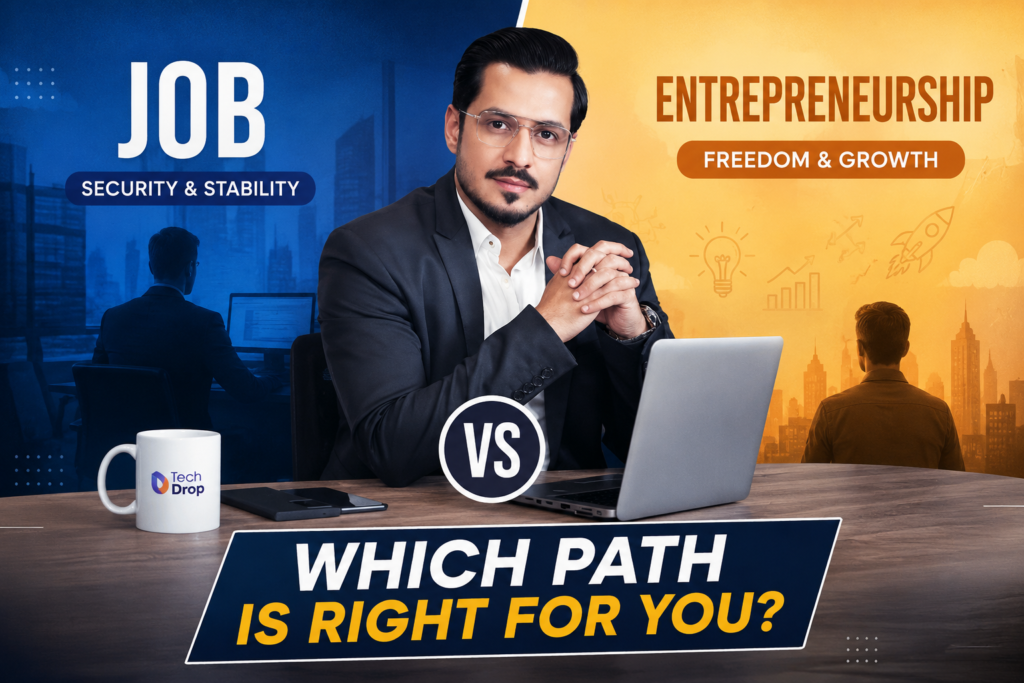
I still remember the day I left a steady paycheck to build my first business in Dubai. I had little money, no safety net, and a lot of doubt from people around me. What I did have was a vision and a stubborn belief that I could build something of my own.
Years later, after building ventures across Pakistan, the UAE, and the United States, I still get asked the same question: “Job vs Entrepreneurship: Should I take a job, or should I become an entrepreneur?” There is no single right answer. But I can walk you through what I have learned, so you can make the choice that fits your life, not someone else’s.
What Is the Difference Between a Job and Entrepreneurship?
A job means you work for someone else. You trade your time and skills for a fixed salary, and your employer carries the financial risk. Entrepreneurship means you build and run your own business. You create the product or service, you find the customers, and you carry the risk yourself. Employment gives you structure. Entrepreneurship gives you ownership. Both are valid career paths. The difference lies in who controls the outcome and who absorbs the risk.
Read Also: What Must an Entrepreneur Do After Creating a Business Plan?
Do You Have an Entrepreneurial Mindset?
Before you compare a job vs entrepreneurship on paper, look inward first. I have met brilliant people who thrive in a corporate job because they love clear goals, steady routines, and working as part of a team. I have also met people who feel trapped by that same structure and come alive when they can make their own decisions. Ask yourself honestly: do you enjoy solving problems without a manual? Can you handle uncertainty without losing sleep? Your mindset matters more than your resume when you choose between employment and building a business. A job often protects your work-life balance, while entrepreneurship demands that your passion carry you through the days when the lines between work and life disappear.
Pros and Cons of a Traditional Job
Pros
- Stability — predictable salary and pay dates
- Benefits — often includes insurance and other perks
- Peace of mind — someone else handles payroll, taxes, and strategy, freeing you to focus on your craft
Cons
- Capped income — your earnings have a ceiling
- Politics over performance — promotions aren’t always merit-based
- Limited control — your schedule usually belongs to someone else
Pros and Cons of Entrepreneurship
Pros
- Unlimited income potential — every improvement you make grows something that’s yours
- Independence — you control your own schedule
- Creative freedom — turn your ideas into real products, services, and movements through innovation
Cons
- You carry the risk — no guaranteed safety net
- No guaranteed salary — income isn’t steady, especially early on
- Demanding start — long hours, personal investment, and patience before things stabilize
Financial Implications: Earning Potential Compared
A job gives you a predictable income. You can plan your life around it. Entrepreneurship works differently. In the beginning, your income may be lower than a stable salary, sometimes for months or even years. But if your business grows, your earning potential can go far beyond what any job would pay you. I have seen this happen in my own ventures and in the businesses I mentor. The financial upside of entrepreneurship is real, but it is earned through patience, not luck.
The Practical Realities of Starting a Business
Starting a business is not just an idea and a dream. It takes capital, even if it is small at first. It takes time to learn skills you never needed as an employee, like sales, cash flow management, and hiring. When I moved from running one company in Dubai to leading a portfolio of businesses in technology, hospitality, coworking, and digital media, I learned that every new venture demands fresh problem-solving. There is no fixed playbook. You become your own boss, and you build the plane while you fly it, knowing that real wealth takes years to build, not months.
Using a Side Hustle to Bridge the Gap
You do not have to choose between a job and entrepreneurship overnight. A side hustle lets you test a business idea while your job still pays your bills. This approach lowers your risk and helps you build confidence, skills, and early customers before you make a full leap. Many entrepreneurs I have mentored started exactly this way, working a job by day and building their idea by night, until the business could stand on its own.
Read Also: Side Hustle vs Business: Which One Will Actually Change Your Life?
Job vs Entrepreneurship: How to Decide
Ask yourself a few honest questions about your own risk tolerance. How much financial risk can you handle right now? Do you have savings to support yourself if income slows down for a while? Are you chasing a steady career path, or are you driven by a bigger purpose you want to build from scratch? I did not choose entrepreneurship because it was easy. I chose it because I wanted to solve real problems and create opportunities for other people, not just for myself. Your reason has to be strong enough to carry you through the hard days.
FAQs
Is it better to be an entrepreneur or an employee?
Neither is universally better. A job offers security and structure. Entrepreneurship offers freedom and higher earning potential, along with higher risk. The right choice depends on your goals, your finances, and your personality.
Is being an entrepreneur a job or a career?
Entrepreneurship is a career path, not a single job. It grows and changes as your business grows, and it can include many roles at once, from strategist to salesperson to leader.
What skills are most important for entrepreneurship?
Problem-solving, adaptability, basic financial management, and the ability to build strong relationships with your team, partners, and customers all matter more than any single technical skill.
Final Thoughts
I do not believe entrepreneurship is for everyone, and that is fine. What matters is that you choose your path with your eyes open.
A job can give you stability and a strong foundation to build on. Entrepreneurship can give you freedom and unlimited opportunity, but only if you are ready to carry the risk that comes with it.
Whichever path you choose, choose it on purpose. Build your career the way I built my businesses: with a clear vision, honest self-awareness, and the belief that you can create something meaningful, one decision at a time.