

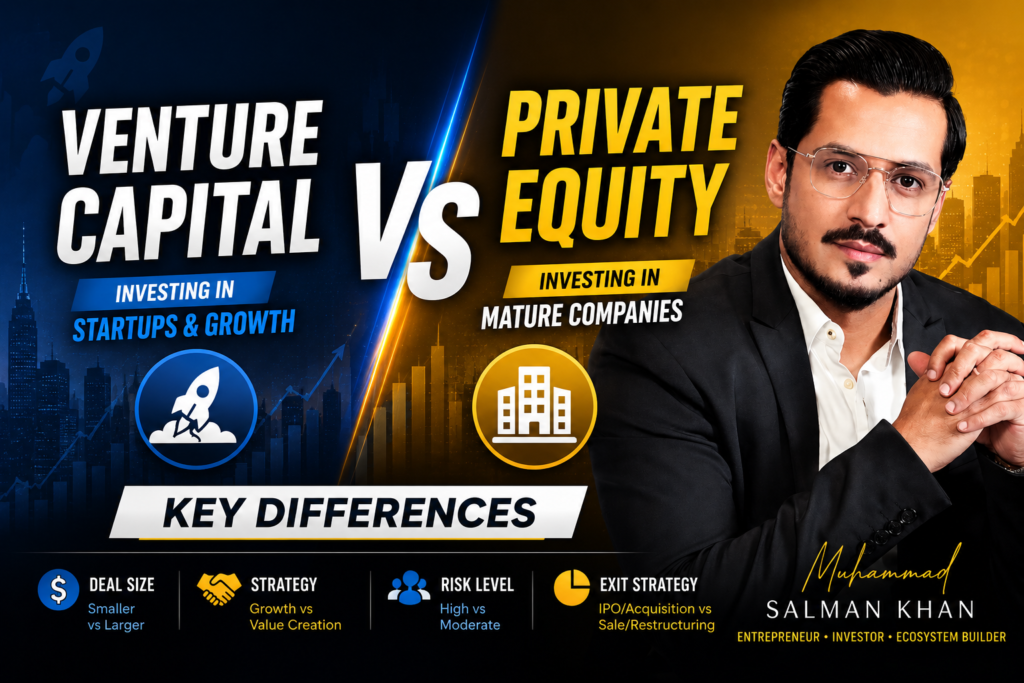
Over the years, I have met hundreds of founders who ask me one question:
“Should I raise venture capital or private equity?”
It is a great question because the answer can completely change the future of a business.
When I launched my first company in Dubai, I did not fully understand how different types of investors think. I simply wanted someone who believed in my vision. As I built businesses across Pakistan, the UAE, and the United States, I learned that not every investor is the right investor.
Today, I lead ventures like Tech Drop Pvt Ltd and Creative Creations, and I regularly speak with founders looking for investment. One lesson has stayed with me throughout my journey.
Money is never just money.
Every investment comes with expectations, experience, and a different roadmap for growth.
That is why understanding venture capital vs private equity is essential for every entrepreneur, business owner, and aspiring investor.
In this guide, I will explain everything in simple words so you can confidently decide whether Venture Capital or Private Equity fits your business goals.
What Are Venture Capital and Private Equity?
Before discussing the key differences, let’s understand both concepts.
Both private equity and venture capital belong to the world of private markets. Instead of buying shares of public companies, these investors put money into privately owned businesses.
Although both make equity investments, their goals, risk levels, and investment methods are very different.
Simply put:
- Venture capital focuses on businesses with high growth potential.
- Private equity focuses on improving established businesses and increasing their value.
Both provide capital, but they invest at different stages of a company’s journey.
Also Read: What Is One Way for an Entrepreneur to Decrease Risk?
What Is Venture Capital?
A venture capital firm provides venture capital funding to a startup or other early-stage companies that have strong growth potential.
In most cases, venture capital firms invest in businesses that have an innovative product but limited revenue.
Instead of asking for immediate profits, they invest in exchange for future success.
As a founder, you usually receive funding in exchange for equity, meaning you give away an equity percentage of your company.
The goal is rapid expansion.
A venture capitalist understands that many startups fail. However, one successful investment can generate outstanding returns.
This is why VC firms accept higher risk than traditional investors.
Common industries where Venture Capital firms invest
- Artificial Intelligence: VC funds back early-stage AI startups for rapid innovation, while PE firms acquire mature AI businesses for scaling and operational optimization.
- SaaS: Venture capital fuels fast-growing SaaS companies with product-market fit, whereas private equity seeks profitable SaaS firms for buyouts and margin improvement.
- FinTech: VCs invest in disruptive FinTech startups focused on user acquisition, while PE targets established financial platforms for consolidation and efficiency gains.
- HealthTech: Venture capital supports early HealthTech innovation and clinical validation, while private equity invests in proven healthcare businesses to expand services and streamline operations.
- EdTech: VCs fund scalable EdTech platforms during growth phases, while PE firms acquire stable education businesses to optimize revenue and distribution.
- E-commerce: Venture capital backs e-commerce startups to boost growth and market share, whereas private equity pursues established e-commerce brands for consolidation and profitability improvements.
- Clean Energy: VCs finance clean energy tech and early-stage projects, while private equity focuses on established renewable assets and infrastructure for long-term returns.
Whenever I mentor founders, I remind them that venture capital investors do not only invest in ideas.
They invest in founders.
Your leadership matters just as much as your business model.
What Is Private Equity?
A private equity firm usually buys significant ownership in businesses that already have stable operations.
Unlike a startup, these companies often generate consistent revenue and profits.
Many private equity firms invest in mature companies, well-established companies, or profitable businesses looking for expansion.
A private equity investment often involves purchasing a controlling stake through a buyout or leveraged buyouts.
Instead of betting on future ideas alone, the goal is value creation.
The firm improves operations, increases profitability, grows cash flow, and later sells the company for a higher valuation.
Many Private Equity firms also help improve leadership, operations, hiring, technology, and financial management.
Venture Capital vs Private Equity
The biggest differences between VC and PE become easier to understand when you compare them side by side.
| Feature | Venture Capital | Private Equity |
|---|---|---|
| Target companies | Startup and early-stage businesses | Mature companies |
| Risk | High | Moderate |
| Ownership | Minority stake | Majority or controlling stake |
| Main objective | Rapid growth | Value creation |
| Company stage | Early stage | Established companies |
| Deal size | Smaller | Larger |
| Exit | IPO or acquisition | Company sale or restructuring |
This comparison explains the biggest differences between venture capital investing and traditional private investments.
1. Investment Strategy
Every investor follows a different strategy.
Venture Capital Strategy
A venture capital firm spreads money across multiple startups.
Since many businesses fail, investors expect only a few winners.
Their investment strategies focus on innovation, disruption, and long-term growth.
Private Equity Strategy
A private equity firm invests in companies that already have predictable income.
Instead of hoping the business succeeds, they improve operations.
Their focus includes:
- Increasing profits
- Reducing costs
- Better management
- Better capital structure
- Improving EBITDA growth
These improvements increase company value before selling it.
Also Read: Angel Investor vs. Venture Capital: Which Is Right for Your Startup?
2. Funding Stage
One of the biggest key differences is timing.
Venture Capital Funding
A startup may receive funding before becoming profitable.
This could happen during:
- Seed stage
- Pre-Series A
- Series A
- Growth rounds
This type of venture capital funding helps founders build products, hire employees, and enter new markets.
Private Equity Funding
PE usually enters after a company has proven its business model.
Instead of funding an idea, they fund growth.
Many private equity deals happen after years of business success.
3. Deal Size
Another major difference is deal size.
A typical VC investment may range from thousands to millions of dollars.
A PE transaction may involve tens or hundreds of millions.
Large fund sizes allow PE firms to buy entire businesses rather than small ownership stakes.
4. Ownership and Equity
Both models involve equity, but ownership is different.
With VC, founders usually remain in control.
The investor owns a minority share.
With PE, investors often purchase controlling ownership.
That means they influence hiring, strategy, expansion, and long-term planning.
This larger equity contribution gives them greater decision-making power.
5. Risk Level
I often tell founders that risk and reward always go together.
A startup has uncertainty.
Customers may change.
Technology may fail.
Markets may shift.
That is why VCs accept more risk.
A private equity firm, however, prefers businesses with predictable revenue and stable customers.
Because these companies already generate cash flow, the overall investment becomes less risky.
6. Value Creation
One phrase you will hear repeatedly in PE is value creation.
Instead of simply investing money, they improve every part of the business.
This includes:
- Better leadership
- Stronger operations
- Digital transformation
- International expansion
- Financial discipline
I personally believe this mindset creates lasting businesses.
Whenever I build a company, whether it is Tech Drop Pvt Ltd or Creative Creations, I focus on creating value before chasing valuation.
Private Equity and Venture Capital
Although people often compare them, venture capital and private equity share several similarities.
Both:
- Invest in private companies
- Provide capital
- Expect long-term returns
- Support founders
- Help businesses scale
- Sit on company boards
- Build strong networks
These similarities between private equity investing and venture investing often confuse new entrepreneurs.
The real difference is when and where they invest.
Which Businesses Do They Invest In?
Venture Capital
Venture capital firms invest in:
- Tech startups
- Innovative products
- Early-stage businesses
- High-growth ideas
Their goal is to support the growth of businesses capable of global expansion.
Private Equity
Private equity firms invest in target mature companies that already have:
- Revenue
- Customers
- Stable operations
- Experienced management
These businesses are often privately held companies with proven business models.
How Investors Make Money
Both investors eventually exit.
| VC Exit | PE Exit |
|---|---|
| Go public | Sell to another investor |
| Get acquired | Sell to a larger corporation |
| Merge with another company | List the company publicly |
| Both depend on increasing company value before selling. | |
Leverage in Private Equity
Unlike VC, PE frequently uses leverage.
Borrowed money helps finance acquisitions.
This approach is common in leveraged buyouts.
If managed correctly, debt increases returns.
If poorly managed, it increases financial risk.
Hedge Funds vs Venture Capital and Private Equity
Many entrepreneurs confuse hedge funds with investment firms.
They are completely different.
Hedge funds usually trade stocks, bonds, currencies, and other financial assets.
VC and PE focus on owning businesses.
Instead of daily trading, they build long-term company value.
Raising Capital as a Founder
When founders ask me how to raise capital, I always tell them to prepare before approaching investors.
Investors look for:
- Strong leadership: Decisive, experienced founders or managers are a key factor investors consider in venture capital vs private equity deals.
- Clear business model: A well-defined revenue plan helps assess growth potential and risk in venture capital vs private equity evaluations.
- Market opportunity: Large, addressable markets drive interest and valuation differences between venture capital vs private equity strategies.
- Financial discipline: Consistent financial controls and performance metrics are critical for success in both venture capital vs private equity investments.
- Competitive advantage: Defensible differentiation or barriers to entry strengthens appeal in venture capital vs private equity comparisons.
- Scalable operations: Operational scalability signals readiness for rapid growth and influences decisions in venture capital vs private equity funding.
Whether you seek Venture Capital or Private Equity, preparation builds confidence.
Private Equity or Venture Capital: Which Is Better?
People often ask me whether private equity or venture capital is better.
There is no universal answer.
It depends on your company.
Choose Venture Capital if:
- You have an innovative startup.
- You need early funding.
- You want fast expansion.
- You can tolerate higher risk.
Choose Private Equity if:
- Your company is already profitable.
- You need operational expertise.
- You want large investments.
- You plan long-term growth.
My Personal View as an Entrepreneur
Throughout my entrepreneurial journey, I have learned that capital alone never builds great companies.
People do.
When I launched my first business in Dubai, I did not have investors waiting in line. I had determination, long working hours, and a vision that refused to fade. As I expanded into Pakistan, the UAE, and the United States, I realized that every stage of business requires different partners.
For an early startup, I believe the right venture capital firm can open doors to networks, mentorship, and global opportunities.
For established businesses, an experienced private equity firm can unlock operational excellence and long-term growth.
I have always believed in building businesses that solve real problems. Through Tech Drop Pvt Ltd and Creative Creations, my focus has never been limited to profits alone. I want to build companies that create jobs, empower talent, and strengthen the entrepreneurial ecosystem.
The right investor should share that vision.
Never accept investment of capital without understanding the expectations that come with it.
The best partnerships are built on trust, shared values, and a long-term mission.
Final Thoughts
Understanding venture capital vs private equity helps every entrepreneur make smarter decisions.
While both operate in the private markets, they serve different purposes.
Venture Capital focuses on innovation, early growth, and ambitious startups.
Private Equity focuses on improving established businesses through operational excellence and strategic expansion.
Neither option is better than the other.
The right choice depends on your company’s stage, goals, and long-term vision.
As someone who has built businesses across different industries and countries, I have learned that choosing the right investor is just as important as choosing the right business idea. Build something valuable first, stay committed to your mission, and the right opportunities to invest in companies and grow together will follow.
FAQ: Venture Capital vs. Private Equity
What distinguishes venture capital vs private equity?
The main differences between venture capital and private equity lie in the stage of companies they invest in, deal size, risk profile, and control. Venture capital (VC) firms and private equity (PE) firms typically back early-stage, high-growth startups versus more mature companies, respectively. VC investments often take minority stakes to fuel growth (including growth equity rounds), while private equity investors frequently acquire majority control of portfolio companies, use leverage, and focus on operational improvement or restructuring. Assets under management, fund strategy, sector focus, and expected time to exit also differ across capital firms and private equity funds.
How do private equity roles differ from venture capital careers?
Private equity roles often emphasize financial engineering, portfolio company operational oversight, and deal execution for larger, mature businesses; responsibilities can include due diligence, modeling leveraged buyouts, and working closely with management of portfolio companies. Venture capital careers focus more on sourcing startups, assessing market potential across sectors, mentoring founders, and monitoring early-stage growth. Both paths involve analyst, associate, and partner tracks, but salary structures, exit opportunities, and day-to-day activities vary between equity and venture capital firms.
How do investment horizons and return expectations compare between PE and VC?
VC firms typically take longer to realize returns because startups need time to scale; they accept higher failure rates but target outsized gains from a few winners. Private equity investors often pursue shorter-to-medium term exits (3–7 years) with returns driven by operational improvements, multiple expansion, and leverage. Investment horizons reflect the different capital deployment styles of private markets, with private equity funds generally concentrating larger capital per deal and VC funds spreading capital across many early-stage portfolio companies.
How do private equity funds and venture capital firms source and evaluate deals?
PE and VC firms use different sourcing strategies: VC scouts, networks, accelerators, and founders often drive deal flow for venture capital firms, focusing on product-market fit and scalable business models. Private equity funds rely more on investment bankers, direct outreach, auctions, and deep sector expertise to find mature targets. Evaluation metrics differ—VC weighs growth potential and market size, while private equity emphasizes cash flows, margins, leverage capacity and synergies with existing portfolio companies.
Can an investor move between VC and PE, and what skills transfer?
Yes. Moving between venture capital and private equity is common but can require skill adaptation. Analytical skills, financial modeling, deal sourcing, and relationship-building are valuable in both. Transitioning from VC to PE may require more emphasis on operational improvement, LBO structuring, and managing larger portfolio companies; moving from PE to VC often demands stronger comfort with uncertainty, sector scouting, and mentoring early-stage founders. Networking with equity and venture capital firms and demonstrating relevant sector expertise can help make the switch.
What steps should I take if I want to get into venture capital from private equity or other backgrounds?
To get into venture capital, build relevant experience: work at a startup, join a sector-focused role, do angel investing, or gain operating experience in portfolio companies. Networking with VC and PE firms, contributing as a scout, publishing sector insights, and demonstrating a track record identifying promising companies help. Formal private markets credentials or experience at growth equity or equity and venture capital firms can also make the transition easier. Highlighting industry-specific expertise, deal sourcing ability, and a clear investment thesis are key to breaking in.
How do VC and PE firms collaborate or overlap in the market?
There is overlap between venture capital and private equity: growth equity sits at the intersection, backing later-stage startups with significant revenue. Some firms operate both VC and PE strategies or partner across rounds—VC firms may stay as minority investors into later rounds that look similar to private equity investments, while PE firms sometimes invest in high-growth sectors or smaller venture-like deals. Both types of equity investors aim to create value for investors, manage portfolio companies, and ultimately exit with returns, and many firms brand themselves as both equity and venture capital firms or as capital firms and private equity groups to reflect this overlap.