
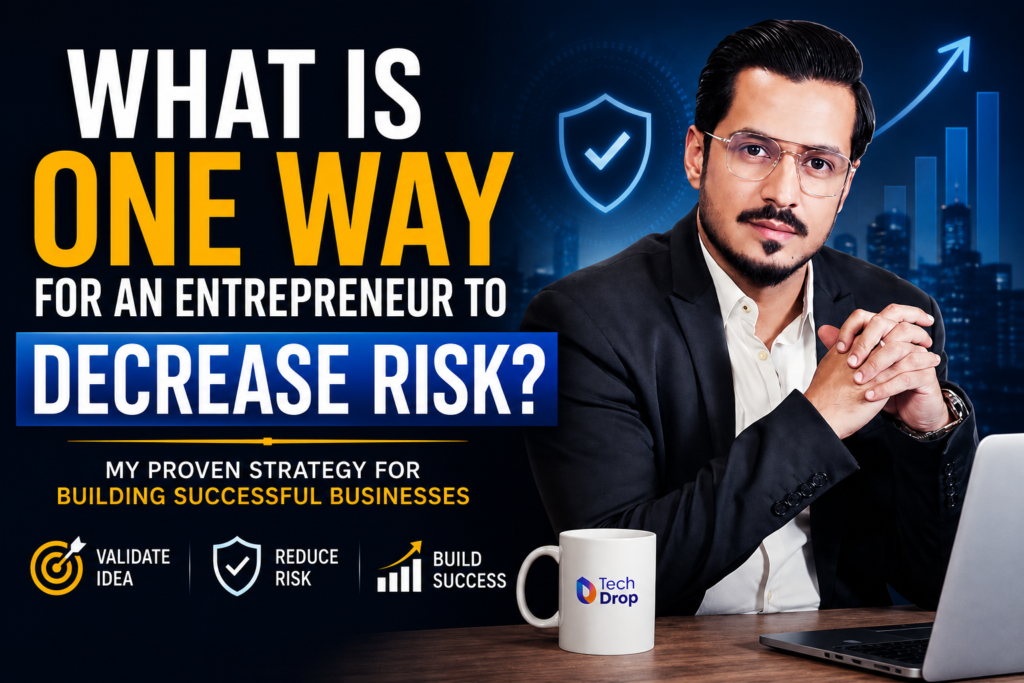
The best way for an entrepreneur to decrease risk is to validate the business idea before investing significant time, money, or resources. I have learned through experience that testing an idea with real customers before scaling helps reduce financial risk, improve decision-making, and increase the chances of long-term success.
Many entrepreneurs believe risk comes from starting a business. I see it differently. The real risk comes from making assumptions instead of collecting facts.
Throughout my entrepreneurial journey, I have built businesses across Pakistan, the UAE, and the United States. Every venture taught me one lesson that never changes:
Test first. Invest later. Scale only when the market proves you are solving a real problem.
That single habit has saved me from expensive mistakes and helped me build businesses that continue to grow.
Why Every Entrepreneur Faces Risk
Risk is a natural part of entrepreneurship. Every founder deals with uncertainty.
When I launched my first business in Dubai, I did not have unlimited funding or a large team. What I had was belief, determination, and the willingness to learn quickly.
I understood one thing from the beginning.
No business idea is perfect on paper.
Customers decide whether an idea succeeds.
That is why entrepreneurs must focus on reducing unnecessary risks instead of trying to eliminate risk completely.
Common business risks include:
- Financial risk
- Market risk
- Operational risk
- Competition
- Cash flow problems
- Hiring the wrong people
- Product market mismatch
- Technology changes
Successful entrepreneurs do not avoid these risks.
They prepare for them.
The One Strategy That Decreased My Risk Every Time
If someone asks me,
“What is one way for an entrepreneur to decrease risk?”
My answer is simple.
Validate the business idea before making a large investment.
Validation means proving that people actually want your product or service.
Instead of asking friends whether your idea is good, ask paying customers.
There is a huge difference.
Real customers provide real feedback.
Money is the strongest form of validation.
My Experience Building Businesses
When I started my entrepreneurial journey, I did not have investors waiting to fund my ideas.
I had to make smart decisions because every dollar mattered.
Instead of building massive products first, I learned to ask questions like:
- Is this problem important?
- Who needs this solution?
- Will customers pay for it?
- What makes my solution different?
- Can I test this before spending more?
These questions protected my business from unnecessary losses.
Today, whether I am working through Tech Drop Pvt Ltd, helping businesses with software development, AI automation, lead generation, virtual assistants, or building brand stories through Creative Creations, I still follow the same principle.
Every successful project starts with understanding customer needs before writing a single line of code or launching a marketing campaign.
That approach has consistently reduced business risk.
Why Validation Matters More Than Perfection
Many entrepreneurs spend months trying to build the perfect product.
I made that mistake early in my career.
Then I realized something important.
Customers do not buy perfection.
They buy solutions.
A simple product that solves one important problem often performs better than a complicated product with dozens of unnecessary features.
Validation allows you to:
- Understand customer pain points
- Improve your product faster
- Save money
- Reduce business uncertainty
- Build customer trust
- Make better financial decisions
Read Also: Angel Investor vs. Venture Capital: Which Is Right for Your Startup?
How to Validate a Business Idea
Here is the process I recommend.
Identify a Real Problem
Every successful business solves a problem.
Before launching anything, ask yourself:
What problem am I solving?
If you cannot answer that question clearly, customers will not understand your business either.
Understand Your Target Audience
Know exactly who your customers are.
Study:
- Age
- Industry
- Location
- Income
- Daily challenges
- Buying behavior
The better you know your audience, the lower your marketing risk becomes.
Talk to Potential Customers
This step is often ignored.
Speak directly with potential buyers.
Ask questions.
Listen more than you talk.
Their feedback is more valuable than your assumptions.
Build a Minimum Viable Product (MVP)
Instead of building everything at once, create a Minimum Viable Product.
An MVP is the simplest version of your product that solves one core problem.
This approach allows you to test demand while spending less money.
Many successful startups began with simple MVPs.
Measure Customer Response
Watch customer behavior carefully.
Do they:
- Visit your website?
- Request demos?
- Purchase your service?
- Recommend your product?
- Return for repeat purchases?
These signals tell you whether your business is moving in the right direction.
Other Smart Ways Entrepreneurs Reduce Risk
Although validation is my favorite strategy, several other habits also reduce business risk.
Build Strong Cash Flow
Cash flow keeps businesses alive.
Profit looks good on paper.
Cash pays salaries.
Cash pays suppliers.
Cash allows you to survive difficult months.
Always monitor your cash flow carefully.
Diversify Revenue Streams
I never like depending on one source of income.
That is one reason I built businesses across different industries.
When one market slows down, another often continues growing.
Diversification creates stability.
Invest in the Right Team
Businesses do not grow because of one person.
They grow because of great people.
Hire individuals who share your values.
Train them.
Trust them.
Empower them.
The right team reduces operational risk significantly.
Keep Learning
Markets change constantly.
Technology evolves.
Customer expectations shift.
I invest time in learning because knowledge reduces uncertainty.
The entrepreneurs who continue learning often make better business decisions.
Study Your Competitors
Competition is not something to fear.
It is free education.
Analyze:
- Their pricing
- Customer reviews
- Marketing
- Services
- Weaknesses
Then improve where they fall short.
The Role of Market Research
Market research gives entrepreneurs confidence.
Before launching a business, collect information about:
- Market demand
- Customer behavior
- Industry trends
- Pricing
- Competitors
- Growth opportunities
Good research replaces guesswork with facts.
Read Also: Rich People Don’t Work Harder, They Work Smarter
Why Data Is Better Than Assumptions
I have met entrepreneurs who were completely convinced their idea would succeed.
Unfortunately, confidence alone does not build profitable companies.
Data does.
Whenever possible, make decisions using:
- Customer interviews
- Sales reports
- Website analytics
- Market research
- Financial projections
- Customer feedback
Numbers tell the truth.
Risk Management Is an Ongoing Process
Many people think risk management happens only before launching a business.
I disagree.
Risk management continues every day.
As a business owner, I regularly review:
- Financial performance
- Customer satisfaction
- Employee productivity
- Market changes
- Business goals
- Technology updates
Small adjustments prevent larger problems later.
Common Mistakes That Increase Business Risk
Over the years, I have seen entrepreneurs make similar mistakes repeatedly.
Avoid these common errors.
Spending Too Much Too Early
Large offices.
Expensive equipment.
Big marketing budgets.
None of these guarantee success.
Grow gradually.
Ignoring Customer Feedback
Customers tell you exactly how to improve.
Ignoring them increases risk.
Listen carefully.
Trying to Do Everything Alone
Delegation allows businesses to scale.
Build systems.
Build teams.
Build leaders.
Entering Every Opportunity
Not every opportunity is worth pursuing.
Focus creates better results than chasing everything.
Making Emotional Decisions
Entrepreneurs are passionate.
That is a strength.
However, business decisions should be based on evidence, not emotions.
What I Tell Young Entrepreneurs
Young entrepreneurs often ask me,
“How do I become successful?”
My answer surprises them.
I do not say work harder.
I say make smarter decisions.
Success comes from reducing unnecessary risk while taking calculated risks that move your business forward.
That mindset has helped me grow companies across different industries and countries.
Practical Checklist to Reduce Business Risk
Before launching your next idea, ask yourself:
- Have I validated my idea?
- Do customers actually need this?
- Have I spoken with potential buyers?
- Do I understand my competitors?
- Can I launch a smaller version first?
- Have I planned my finances?
- Do I know my target audience?
- Have I tested pricing?
- Do I have a backup plan?
- Am I making decisions using real data?
If most of these answers are yes, you are already reducing your business risk.
Read Also: 13 Things Mentally Strong People Don’t Do
Final Thoughts
If there is one lesson I have learned after building businesses across multiple industries and countries, it is this:
Do not fall in love with your idea. Fall in love with solving a real problem.
That mindset has guided me from launching my first business in Dubai to leading ventures like Tech Drop Pvt Ltd and Creative Creations, while working with talented people across Pakistan, the UAE, and the United States.
Entrepreneurship will always involve uncertainty. That is part of the journey.
But uncertainty does not have to become unnecessary risk.
Validate your ideas.
Listen to customers.
Manage your finances wisely.
Build strong teams.
Keep learning.
Most importantly, make decisions based on facts rather than assumptions.
That is the one habit that has protected my businesses, strengthened my confidence, and allowed me to build companies that create lasting value.
FAQ’s
What is one way for an entrepreneur to decrease risk?
The most effective way is to validate the business idea before investing heavily. Test your idea with real customers, gather feedback, and confirm there is demand before expanding.
Why is market validation important?
Market validation helps entrepreneurs understand whether customers actually want their product or service. It reduces financial risk, improves product development, and supports smarter business decisions.
How does a Minimum Viable Product reduce risk?
An MVP lets entrepreneurs launch a basic version of a product with fewer resources. Customer feedback from an MVP helps improve the product before making larger investments.
Can risk ever be eliminated in business?
No. Every business involves some level of risk. The goal is to reduce unnecessary risk through planning, research, testing, and informed decision-making.
What skills help entrepreneurs reduce risk?
Critical thinking, financial management, market research, communication, leadership, adaptability, and data analysis all help entrepreneurs make better decisions and lower business risk.