What is Social Entrepreneurship?
Discover the essence of social entrepreneurship with Muhammad Salman Khan, exploring innovative solutions that create positive social impact and drive meaningful change.
5/15/20267 min read
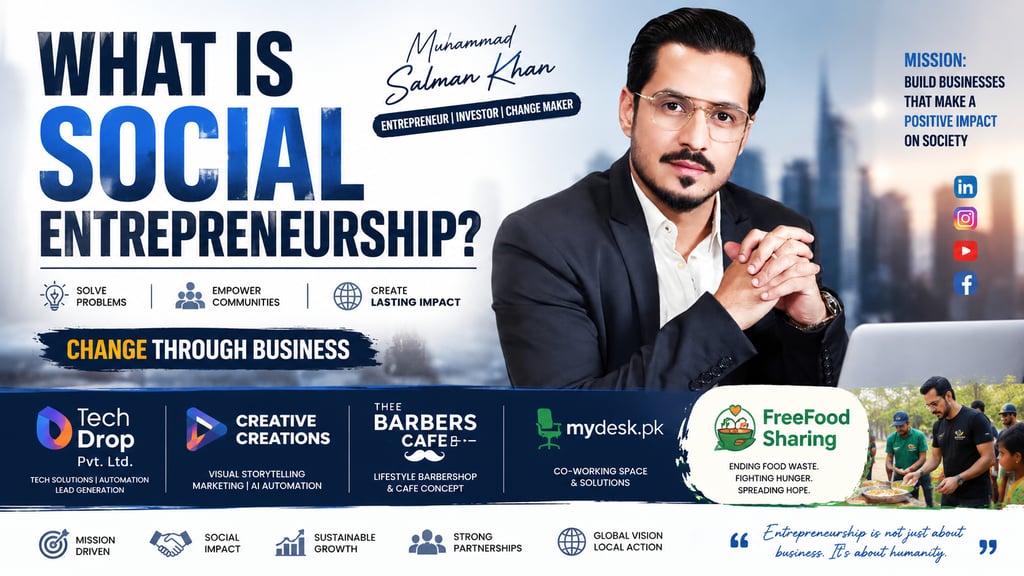

When I first stepped into the world of business, I thought success was only about growth, profits, and survival. But over the years, I learned something much bigger. A business can also solve problems, help communities, and create opportunities for people who need them the most. That is the true meaning of social entrepreneurship.
As a serial entrepreneur, investor, and ecosystem builder, I have seen how businesses can transform lives. From building companies in Dubai to launching ventures in Pakistan, the UAE, and the United States, my goal has never been just money. I wanted to build businesses that leave a real impact on society.
In this article, I will share my experience and explain the concept of social entrepreneurship, how a social entrepreneur works, why this model matters today, and how businesses can become a force for good.
What Is Social Entrepreneurship?
The simplest way I explain social entrepreneurship is this: it is the process of building businesses that solve human problems while still operating like a real business.
A social entrepreneur does not only focus on revenue. Their main goal is to create meaningful change while keeping the company financially healthy. Unlike a normal company that focuses only on profit, a mission-driven business looks at both income and impact.
The concept of “social entrepreneurship has become more important in today’s world because many communities face serious challenges like hunger, unemployment, poor education, and environmental challenges. Governments alone cannot solve everything. Businesses also need to step forward.
When I launched ventures like Tech Drop Pvt. Ltd., Creative Creations, One21 Consulting, and The Barbers Cafe, I always wanted them to become more than just companies. I wanted them to create jobs, empower youth, and support communities. That is what change through business means to me.
What Makes a Social Entrepreneur Different From Traditional Entrepreneurs?
A social entrepreneur and a regular entrepreneur both build businesses, take risks, and solve problems. But their purpose is different.
Traditional entrepreneurs usually focus on market share, profit margins, and expansion. Their businesses aim to create financial success first. On the other hand, social entrepreneurs incorporate purpose into every decision they make.
For example, my nonprofit initiative FreeFoodSharing was created to fight hunger and reduce food waste. During Ramadan, we distributed meals to poor families across Karachi. That experience changed me deeply. It showed me that entrepreneurship is not only about business growth. It is also about humanity.
Many traditional entrepreneurs measure success only by money. A social entrepreneur measures success by both profit and positive impact. They focus on solving a social problem, helping communities, and building a better future.
Organizations like Ashoka have supported thousands of changemakers around the world. Their work proves that businesses can positively impact society while remaining financially strong.
Why Is Social Entrepreneurship Important Today?
We live in a world where millions of people still struggle with poverty, hunger, unemployment, and lack of education. Businesses can no longer ignore these pressing social problems.
This is where social entrepreneurship becomes powerful. It gives people the ability to address social issues while also building sustainable companies. Instead of waiting for others to fix problems, entrepreneurs can step in and create solutions.
I believe modern consumers also care more about purpose today. People support brands that show empathy, responsibility, and honesty. Customers want businesses that care about people and the planet, not just profits.
That is why many companies now focus on corporate social responsibility, sustainability, and ethical business practices. They understand that a business that prioritizes people creates stronger trust and long-term loyalty.
In my own journey, I learned that building businesses with purpose creates deeper motivation. When your mission is bigger than money, you stay committed even during difficult times.
Also Read: True Leadership Starts When Everything Falls Apart
How Does a Social Enterprise Work?
A social enterprise works like a normal company, but its mission includes solving a community issue or creating positive social value.
Some businesses operate as a nonprofit, while others are fully for-profit companies. The structure depends on the founder’s vision and strategy. The important thing is that the business combines financial growth with social and environmental impact.
A good business model is very important in social entrepreneurship. Without a strong system, even the best mission can fail. Social entrepreneurs work hard to balance income, operations, customer needs, and community impact at the same time.
When I mentor young founders through One21 Consulting, I always tell them this: before you launch anything, develop a business model that supports both profit and purpose. Your mission alone is not enough. Your operations must also be sustainable.
A strong social entrepreneurship model usually includes:
Clear mission
Revenue strategy
Community impact
Long-term sustainability
Strong partnership network
This balance helps create a sustainable business that can continue serving people for years.
What Are Some Real Examples of Social Entrepreneurship?
There are many inspiring examples of social entrepreneurship around the world.
One famous example is TOMS. Founder Blake Mycoskie created a simple but powerful idea. For every pair of shoes sold, the company donated a pair of shoes to children in need. This “every pair” model became globally recognized.
The story of TOMS inspired many entrepreneurs because it showed how a business could combine commerce with compassion. Every pair of shoes purchased helped someone else. That model created both revenue and social value.
Another strong example is Warby Parker. The company built a business around affordable eyewear while also helping communities access vision care. Businesses like Warby Parker prove that companies can solve real-world problems while remaining profitable.
Microfinance is another great example. Many organizations provide small loans to underserved communities so people can start their own businesses. This approach helps families escape poverty and build financial independence.
These businesses make a positive impact because they focus on people, not just transactions.
How FreeFoodSharing Helped Me Understand Social Responsibility
One of the most emotional experiences in my life came through FreeFoodSharing.
We started this initiative with one simple mission: to make sure no family sleeps hungry. During Ramadan, our teams distributed meals across Karachi to underserved communities. We saw children waiting for food, families struggling to survive, and workers who could barely afford basic meals.
That experience completely changed my understanding of social entrepreneurship.
I realized that businesses have a duty beyond profits. They have the power to restore dignity and hope. This is the true meaning of social responsibility.
FreeFoodSharing may operate as a nonprofit initiative, but it also taught me important lessons about leadership, empathy, and purpose. It reminded me that entrepreneurship should directly impact human lives.
As a social entrepreneur, I believe helping others is not optional. It is part of leadership.
This initiative also strengthened my mission to make businesses more human. Whether through technology, hospitality, media, or philanthropy, I now try to build ventures that create positive change.
Can a Mission-Driven Business Still Make a Profit?
Many people think a purpose-based business cannot make money. I strongly DISAGREE.
A mission-driven company can absolutely become a successful business. In fact, many purpose-driven brands perform better because customers trust them more.
The key is BALANCE.
You need a smart business plan, good operations, strong branding, and financial discipline. At the same time, you must stay connected to your social cause.
I have built both for-profit ventures and community initiatives. In my experience, purpose actually improves business performance because employees, customers, and partners feel emotionally connected to the mission.
Companies today also attract impact investors when they focus on social and environmental performance. Investors now look for businesses that follow standards of social and environmental responsibility while still generating returns.
Some companies even apply for B Corp certification to prove their commitment to ethics and sustainability.
The future belongs to businesses that combine profit with purpose.
How Do Social Entrepreneurs Create Sustainable Change?
Creating temporary help is good, but creating sustainable change is even better.
A social entrepreneur does not only donate money. They build systems that continue helping people long term.
For example, instead of only giving short-term aid, businesses can create jobs, train youth, improve education, or support local economies. This creates lasting social value.
At Tech Drop Pvt. Ltd., we hire and mentor young professionals in technology and digital services.
At Creative Creations, we help brands tell stories that inspire action.
Through One21 Consulting, we guide startups and help founders grow smarter businesses. We also provide consultations to businesses, investors, startups, and students to obtain scholarships and go abroad for higher studies.
All these ventures contribute to positive social progress in different ways.
I believe entrepreneurship should solve social and environmental challenges together. Businesses should explore social innovation while also protecting communities and resources.
Many modern entrepreneurs now align their companies with the Sustainable Development Goals because they want to make a positive impact beyond revenue.
That mindset creates sustainable growth for both businesses and society.
What Challenges Does a Social Entrepreneur Face?
The journey of a social entrepreneur is rewarding, but it is not easy.
One major challenge is funding and resources. Many investors still focus only on profits and may not immediately understand a social mission. This makes fundraising harder for purpose-driven startups.
Another challenge is balance. You must manage both financial goals and community impact at the same time. If you focus only on purpose without strong operations, the business may fail. But if you focus only on profits, the mission gets lost.
I also learned that building trust takes time. Communities need to see genuine action, not marketing slogans.
When I returned to Pakistan after spending years in Dubai, I wanted to bring innovation and global experience back home. But building systems, partnerships, and teams required patience and persistence.
Still, every challenge teaches valuable lessons. A true innovator continues learning, adapting, and improving.
Also Read: 10 Common Startup Mistakes to Avoid in 2026
How Can Young Entrepreneurs Start Their Own Businesses for Social Good?
I always encourage young people to think bigger than just income.
If you want to enter social entrepreneurship, start by identifying a real issue around you. Maybe your city struggles with waste management, unemployment, education, healthcare, or food insecurity.
Then ask yourself one question:
How can I solve this problem through business?
Your answer can become the foundation of your venture.
Start small if needed. You do not need millions to begin. My own journey started with limited resources but a strong vision.
Focus on these steps:
Understand the problem deeply
Build a clear business plan
Create a simple solution
Test your idea in the real world
Build partnerships
Prioritize people and impact
Stay financially disciplined
Young entrepreneurs should also learn from nonprofits, successful founders, and community leaders. Study how businesses create positive social outcomes while remaining profitable.
The goal is not just to make money. The goal is to create a business that improves lives.
That is the true impact on society.
Final Thoughts
For me, social entrepreneurship is not a trend. It is a mindset.
I believe businesses should do more than generate revenue. They should solve problems, empower communities, and inspire hope. Every venture I build carries this belief at its core.
Whether through FreeFoodSharing, Tech Drop, The Barbers Cafe, or One21 Consulting, my mission remains the same: use entrepreneurship as a force for good.
The world does not only need more companies. It needs more businesses with purpose, empathy, and courage.
If more entrepreneurs focus on meaningful change, we can build a future where businesses help people grow, communities thrive, and opportunities become accessible to everyone.
That is the power of successful social entrepreneurship.