

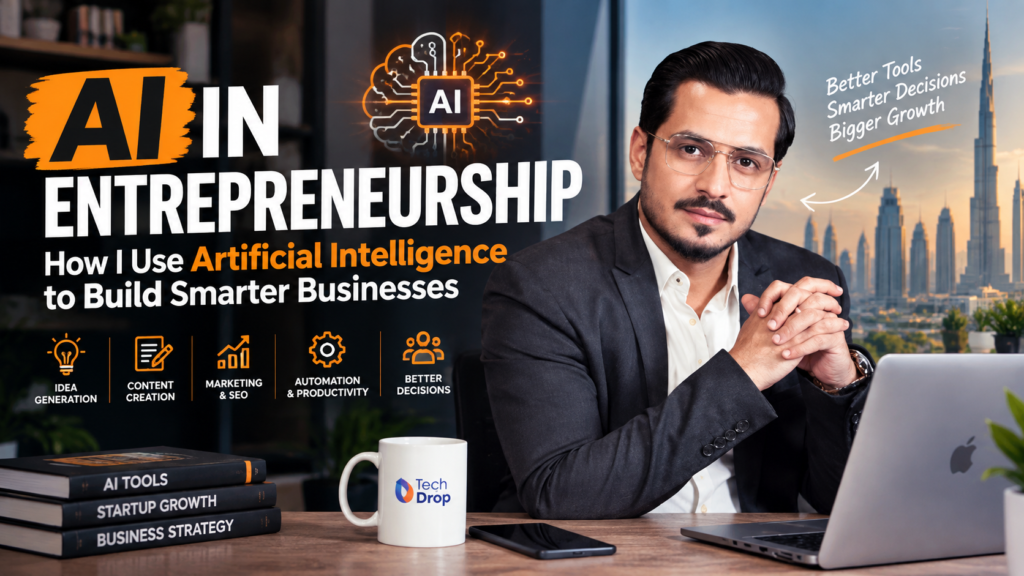
I still remember the early days of building my first business in Dubai. I had a vision, a lot of hustle, and very little else. There was no smart software to guide my decisions. Every plan came from instinct, long nights, and trial and error. Today, when I look at how AI in entrepreneurship has changed the game, I sometimes wish I had these tools back then. But I am grateful I get to use them now, across every venture under M4 Group.
I am not writing this as a researcher or a tech expert. I am writing this as an entrepreneur who has built businesses across technology, hospitality, grooming, coworking, digital media, wellness, and social impact. I have mentored startups, launched a new venture more than once, and watched digital technologies reshape almost every industry I touch. I have watched artificial intelligence move from a buzzword to a real partner in my entrepreneurial process. This article is my honest take on what AI means for entrepreneurs today, how I use it, and where I think it is heading.
What AI in Entrepreneurship Really Means to Me
When people ask me about the role of AI in entrepreneurship, I tell them it is not about replacing the entrepreneur. It is about giving the entrepreneur superpowers. Artificial intelligence helps me process information faster, spot patterns I would have missed, and test ideas before I commit real money to them. I still make the final call. AI just helps me make it faster and with more confidence.
For me, entrepreneurship has always meant solving real problems and creating opportunities for people. AI technologies simply give me more ways to do that. Whether I am reviewing a new business idea or trying to understand a market I have never entered before, I use AI as a thinking partner, not a replacement for judgment.
Also Read: What is Social Entrepreneurship?
How I Use AI Tools Across My Ventures
Running a diversified group of businesses across Pakistan, the UAE, and the United States means I am constantly switching between industries. AI tools help me stay sharp without stretching myself too thin.
At Taboon Mediterranean Grill, Blaze Halal Burgers, and Bella Tavola Pasta, I use AI systems for demand forecasting, menu testing, and customer feedback analysis. Instead of guessing which dish will perform well next season, I look at analytics pulled together with the help of AI, then combine that with my own experience in the food and hospitality space.
As an Equity and Technology Partner in GoLive Streamer, I see AI integration from a completely different angle. There, AI is not just a support tool. It shapes product decisions, content recommendations, and platform growth. Working closely with the tech team, I have learned how AI capabilities can directly affect user engagement and retention on a streaming platform.
Across M4 Group, I also use AI to automate repetitive business processes such as scheduling, reporting, and basic customer communication. This frees up my time and my team’s time for the things that truly need a human touch, like building relationships and making strategic calls. It has also given me real-world proof that AI improves speed within the business without taking away the personal side of hospitality.
AI and Business Model Innovation
One thing I have learned over the years is that a good idea is not enough. You need a business model that can actually survive in a competitive business environment. This is where AI has become one of my favorite tools for business planning.
Before I launch a new venture, I use AI to run different business models against each other. I ask it to help me think through pricing, cost structures, and possible risks. It does not give me the final answer, but it gives me a faster starting point. This has changed how I approach business model innovation. Instead of spending weeks on manual research, I can test five or six scenarios in a single afternoon.
AI also plays a role in my broader business strategy. I use it to track industry trends, understand competitor movement, and identify gaps in the market. This kind of digital transformation is no longer optional for entrepreneurs who want to stay relevant. It has become part of how I think, plan, and grow.
The AI Tools Every Entrepreneur Should Know
I get this question a lot from young entrepreneurs I mentor: which AI tools should I actually use? My honest answer is that it depends on what you are building, but a few tools have earned a permanent place in my routine.
ChatGPT is one of the first tools I turn to when I need to think out loud. I use it to draft messages, brainstorm names for new ventures, and even challenge my own assumptions about a business idea. Generative AI, in general, has made it easier for entrepreneurs like me to create content, test messaging, and move faster without hiring a full team for every small task.
Beyond that, I rely on AI-driven tools for basic analytics, social media posts, and customer insights. Integrating AI into daily operations does not have to be complicated. Most entrepreneurs I know start small, with one or two tools, and build from there as they get more comfortable with the technology. This is how many startups capitalize on AI without overspending in the early days.
The Challenges and Ethics of Using AI in Business
I would not be honest if I only talked about the benefits. AI in entrepreneurship comes with real opportunities and challenges. Data privacy is one of my biggest concerns, especially when I am handling customer information across different countries with different rules and expectations.
Ethical AI use also matters to me personally. I believe technology should support people, not replace their dignity or their livelihood. When I bring AI into any of my businesses, I think carefully about how it affects my team members, not just my bottom line. I have seen entrepreneurs rush into automation without thinking about the people behind the process, and I try hard not to make that mistake.
There is also the challenge of keeping up. AI tools change so quickly that what worked last year might already feel outdated. I have accepted that staying current is now part of running a modern business, the same way staying current with market trends always was.
The Skill Set Entrepreneurs Need in the Age of AI
Entrepreneurship education is changing because of AI, and I think that is a good thing. The skill set that helped me succeed a decade ago is not exactly the same skill set young entrepreneurs need today.
Curiosity still matters most. Beyond that, I tell people to focus on critical thinking, basic data literacy, and the ability to ask AI the right questions. Prompt engineering sounds technical, but really it is just about learning how to communicate clearly with a tool so it gives you something useful back.
I also believe entrepreneurial leadership still comes down to people skills. AI can help you analyze a market, but it cannot build trust with your team, your partners, or your community. That part is still, and always will be, on us as entrepreneurs.
The Future of AI-Driven Entrepreneurship
Looking ahead, I believe the future of entrepreneurship will be shaped by how well entrepreneurs blend human judgment with AI capabilities. Digital entrepreneurship is growing fast, and AI-driven business models are becoming the norm rather than the exception, especially for online business and tech-focused startups.
My own vision is to keep building businesses that are commercially strong, globally connected, and socially meaningful. I want to use AI to open doors for entrepreneurs, professionals, and communities, especially in Pakistan, where I believe talent is ready to compete on a global stage if given the right tools and support.
For me, integrating AI into my ventures is not just about efficiency. It is about creating more opportunities, faster, so I can focus my energy on the human side of business: mentoring, community work, and building platforms that create real social impact.
Final Thoughts
AI in entrepreneurship is not a trend I am watching from a distance. It is part of how I build, lead, and grow every single day. From my food brands to GoLive Streamer, artificial intelligence now sits quietly behind many of my biggest decisions, while the heart of the business still comes from people, purpose, and persistence.
I believe entrepreneurship is a force for good. AI, used the right way, can make that force even stronger. My journey is still being built, and I plan to keep using every tool available, including AI, to make sure that journey creates real value for the people around me.