

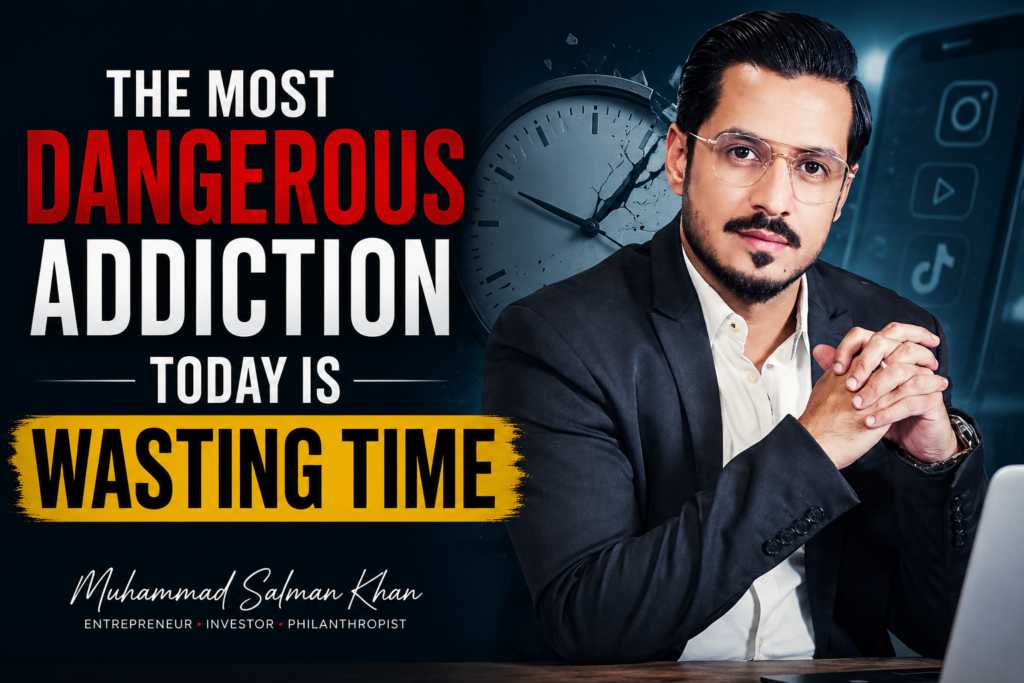
I am Muhammad Salman Khan, and I want to talk to you about something that looks harmless but quietly destroys lives every single day.
It is not always drugs. It is not always alcohol. It is not even always money.
In my experience, the most dangerous addiction today is wasting time.
That may sound simple. But if you really think about it, time-wasting addiction sits behind many modern struggles. It hides inside social media addiction, comfort scrolling, endless videos, late nights on the phone, and the false belief that there is always tomorrow. It steals dreams in a silent way. It does not hit you all at once. It takes you piece by piece, hour by hour, day by day.
I have seen this in people around me. I have seen it in young entrepreneurs with brilliant ideas. I have seen it in talented people who had everything needed to win, except focus. And if I am honest, I have also seen moments of it in myself. When you build businesses, lead teams, and carry big goals, you quickly learn one truth: the biggest gap between who we are and who we can become is often how we use our time.
My journey started with very limited resources. I built my first business in Dubai with vision, hustle, and belief. Over the years, I worked across Pakistan, the UAE, and the United States. I built ventures in technology, media, hospitality, grooming, wellness, and philanthropy. I learned that business growth is not only about capital, strategy, or timing. It is also about discipline. It is about protecting your attention. It is about saying no to easy distractions so you can say yes to meaningful progress.
Today, we live in an attention economy. Big platforms compete for every second of our focus. Instagram, TikTok, YouTube Shorts, Facebook, X, and even LinkedIn are designed to keep us engaged. The more time we spend, the more these systems win. But what about us? What about our goals, our families, our health, our businesses, and our future?
That is why I believe wasting time has become one of the most dangerous addictions of our age.
Why Wasting Time Feels So Normal Today
The scary part is this: wasting time no longer feels like a problem. It feels normal.
We open our phones for one message and end up scrolling for an hour. We tell ourselves we are taking a short break, but that break turns into a habit. We watch content not because it helps us, but because it comforts us. This is where comfort scrolling begins.
Comfort scrolling is not always about entertainment. Sometimes it is an emotional escape. When life feels hard, uncertain, or stressful, scrolling gives the brain quick relief. It offers distraction, novelty, and small dopamine hits. In simple words, it makes us feel better for a few minutes. But over time, it trains us to avoid discomfort instead of facing it.
That is dangerous.
Real growth needs discomfort. Building a company is uncomfortable. Learning a skill is uncomfortable. Fixing your life is uncomfortable. Healing, changing, improving, and starting again all require effort. But social media gives us an easy exit. It gives us fast pleasure without progress.
This is why so many people stay busy but do not move forward.
Social Media Addiction Is More Serious Than Most People Think
Many people still laugh when they hear the phrase social media addiction. They say, “Everyone uses social media.” That is true. But using a tool and being controlled by a tool are two different things.
A healthy user opens an app with purpose.
An addicted user opens an app on impulse.
That difference changes everything.
Social media addiction affects attention span, sleep quality, productivity, emotional stability, self-esteem, and decision-making. It creates a comparison. It creates urgency without importance. It creates the illusion of connection while increasing loneliness in many cases.
I have met talented people who wanted to launch startups, write books, build careers, learn sales, improve fitness, or help their families. But every day, they gave their best hours to scrolling. Not because they were lazy. Not because they lacked talent. But because distraction had become their daily routine.
When a person keeps feeding distractions, delayed dreams become a lifestyle.
Delayed Dreams Are the Hidden Cost of Wasted Time
This is the part that hurts the most.
The real damage of wasted time is not the lost hour. It is the delayed dream.
It is the business you never launched.
It is the skill you never mastered.
It is the book you never wrote.
It is the family time you never gave.
It is the health you said you would fix next month.
It is the life you kept postponing.
Most people do not fail because they are incapable. They fail because they keep delaying meaningful action. They wait for the right mood, the perfect plan, the perfect timing, or the perfect confidence. Meanwhile, time keeps moving.
I have built businesses from the ground up. I have worked through uncertainty, risk, and pressure. I can tell you from real life that momentum is far more powerful than perfection. Small daily action changes lives. But wasted time kills momentum before it has a chance to grow.
That is why I say time-wasting is not a small habit. It is a major life issue.
The Psychology Behind Time-Wasting Addiction
To beat this problem, we need to understand it.
Wasting time is often linked to procrastination, dopamine loops, behavioral addiction, instant gratification, avoidance behavior, and low mental energy.
Let me simplify that.
Our brain likes easy rewards. Social media gives us endless quick rewards:
- new videos
- likes and comments
- funny clips
- breaking news
- gossip
- viral opinions
- short-term emotional relief
This creates a loop:
- I feel bored, stressed, or overwhelmed.
- I pick up my phone.
- I scroll and feel temporary relief.
- I avoid my real task.
- I feel guilty later.
- I need more escape.
- I scroll again.
This is how the cycle grows.
Over time, the mind gets trained to avoid deep work and hard effort. That is why tasks that matter begin to feel heavier. Reading feels boring. Planning feels difficult. Work feels slow. Real conversations feel less exciting than digital stimulation. This is not because the task is impossible. It is because the brain has become used to instant reward.
This is why digital wellness, focus management, and self-discipline matter more today than ever before.
My Experience as an Entrepreneur
As someone who has built companies across different industries, I have learned that time is more valuable than money.
Money can return. TIME cannot.
When I started my first venture in Dubai, I did not have endless resources. I had to make every hour count. Later, when I expanded across markets and built businesses in technology, creative services, wellness, hospitality, and community impact, the lesson became even clearer. Growth does not come from motion alone. It comes from meaningful action done again and again.
At Tech Drop Pvt. Ltd., we solve business problems with software, mobile applications, lead generation, virtual assistants, design automation, and practical tech solutions. At Creative Creations, we focus on brand storytelling, marketing, AI automation, and video production. In all of this work, one thing stays true: execution wins.
Ideas are everywhere.
Execution is rare.
And execution needs focused time.
That is why I always tell young founders, freelancers, marketers, and creators: if you cannot manage your attention, you will struggle to manage your future. A distracted mind cannot build a strong company. A restless routine cannot create a lasting impact. If your phone controls your day, your goals will always stay behind your habits.
The Modern Trap: Feeling Productive Without Producing Anything
One of the biggest problems today is fake productivity.
People consume business content all day and think they are growing.
They watch motivational videos and think they are taking action.
They save posts, bookmark threads, and collect ideas, but never build anything from them.
This creates a false sense of progress.
I call this the “almost productive” trap. It looks smart from the outside. You are watching podcasts, following experts, reading captions, checking trends, listening to advice. But at the end of the day, what did you actually produce?
Did you write the proposal?
Did you call the client?
Did you launch the campaign?
Did you create the system?
Did you start the company?
Knowledge matters. Learning matters. But passive consumption is not the same as execution. Too many people are drowning in content and starving for action.
How Wasting Time Damages Mental Health
We also need to talk about the emotional side.
Wasting time is not only a productivity issue. It is also a mental health issue.
When people keep delaying important things, they often feel:
- guilt
- anxiety
- regret
- low self-worth
- stress
- frustration
- loss of confidence
Why? Because deep inside, they know they are capable of more.
There is pain in underuse.
There is pain in knowing you are meant for something bigger, but spending your days in distraction. This creates inner conflict. You want growth, but your habits create stagnation. You want success, but your routine feeds escape. You want peace, but your screen time increases noise.
That kind of life drains the spirit.
I believe many people do not need more motivation. They need more honesty. They need to admit that time is being wasted and that the cost is becoming too high.
Signs You May Be Addicted to Wasting Time
Let me make this practical.
You may be addicted to wasting time if:
- You check your phone without a reason
- You scroll when you feel stressed
- You delay important work even when you know it matters
- You spend more time consuming content than creating value
- You often say “I will start tomorrow”
- You feel busy all day but finish very little
- You lose sleep because of late-night scrolling
- You compare your life to others online and feel worse
- You want change, but keep escaping the work it requires
If several of these sound familiar, do not feel shame. Feel awareness. Awareness is the first step toward change.
How I Fight This in My Own Life
I do not believe in pretending to be perfect. I believe in building systems that protect purpose.
Here are some practices that help me stay focused:
1. I remind myself that time is life
This sounds basic, but it changes perspective. Time is not just hours on a clock. Time is my energy, my relationships, my mission, and my legacy.
2. I start with important work early
The first part of the day matters. If I give my best energy to scrolling, messages, and noise, I weaken the whole day.
3. I create before I consume
This is a powerful rule. Before taking in the world’s opinions, I try to do my own meaningful work first.
4. I reduce digital noise
Not every notification deserves my attention. Not every trend deserves a reaction. Not every message is urgent.
5. I stay close to purpose
Purpose is one of the strongest weapons against distraction. When your mission is clear, random noise becomes less attractive.
These habits are simple, but they protect what matters.
How You Can Stop Wasting Time and Reclaim Your Life
If you want to change this pattern, start small but start seriously.
1. Track your screen time
You cannot fix what you do not measure. Look honestly at how much time you spend on your phone, especially on Instagram, TikTok, YouTube, and similar apps.
2. Remove easy triggers
Turn off unnecessary notifications. Keep distracting apps off your home screen. Create friction between impulse and action.
3. Replace scrolling with a clear action
When you feel the urge to scroll, do one useful thing first:
- Write one paragraph
- Send one email
- Take one walk
- Review one goal
- Make one sales call
4. Use time blocks
Give your day structure. Schedule work, rest, reading, family time, and learning. A planned day leaves less room for mindless drift.
5. Practice a digital detox
You do not need to disappear from the internet forever. But regular breaks can reset your mind. Even a few hours without your phone can improve focus.
6. Build tolerance for boredom
This is underrated. Constant stimulation weakens attention. Let your brain experience quiet. Real thinking often begins where endless scrolling ends.
7. Remember your future self
Ask yourself one question often: “Will this action move my life forward or delay it?”
That question has power.
Why This Matters for Entrepreneurs, Creators, and Young Professionals
If you are building a career, a brand, or a business, this issue matters even more.
The world rewards people who can focus.
In business, attention is leverage. Clear thinking leads to a better strategy. Consistent work leads to stronger systems. Strong systems create revenue, jobs, partnerships, and impact.
I have spent years building ventures, mentoring people, supporting communities, and connecting markets with opportunity. None of that happens through random effort. It happens through intentional action repeated over time.
That is why I believe the future belongs to people who can protect their attention in a distracted world.
Not just the smartest people.
Not just the richest people.
But the people who can stay committed when distraction is easy.
A Message From Me to You
If you feel stuck, I want to tell you something honestly: your life may not need a complete reset. It may need a better relationship with time.
Do not underestimate what focused months can do.
Do not underestimate what one disciplined year can create.
Do not underestimate what happens when you stop feeding distraction and start feeding purpose.
Your dream may not be dead. It may just be delayed.
And if it is delayed, you still have a chance to act.
I say this with full conviction from my own journey. I started with a vision and built through hustle, risk, discipline, and belief. I have seen how businesses grow, how people transform, and how communities rise when action replaces excuses. I have also seen how easily talent gets buried under comfort.
Please do not let comfort scrolling become the thief of your future.
Please do not trade your potential for temporary relief.
Please do not spend your best years watching other people live while you postpone your own calling.
Final Thoughts
The most dangerous addiction today is wasting time because it looks harmless while causing serious damage.
It steals focus.
It delays dreams.
It weakens discipline.
It feeds anxiety.
It keeps people entertained but unfulfilled.
Social media addiction, dopamine-driven scrolling, instant gratification, procrastination, and digital overload are not small lifestyle issues anymore. They are shaping careers, relationships, mental health, and personal destiny. If we do not take this seriously, we will keep raising generations that consume more than they create.
I believe we can do better.
I believe you can do better.
Use social media as a tool, not as a trap. Protect your attention. Respect your time. Build habits that honor your future. Because in the end, the life you want is not built on your intentions. It is built into how you spend your days.
And if there is one lesson I have learned through entrepreneurship, leadership, and life, it is this:
When you protect your time, you protect your destiny.